Monday, July 07, 2008

Sermons on James

For those interested, I've added an rss feed on the sidebar for the sermon-series I'm preaching through the book of James. Whenever sermons from that series are put online, it will be posted here as well. As always through sermonaudio, the sermons are free to download, or else you can stream them directly from the website.

Our sermonaudio homepage is here.
The homepage for the series on James is here.

Friday, July 04, 2008

A Friday Meditation on the Psalms

In keeping with our current theme, I wanted to post something on interpreting the Psalms today. That being said, I am scrambling to get up to the cottage, so I didn't have time to write something new and thoughtful. But I came across this in my journal from a while ago, and it 'just happened' to be a meditation on one of the Psalms I'm reading today.

This is a model, but not an explanation, of one method that I've found helpful in interpreting and applying the Psalms to my heart. I pray through the Psalm using the 'How Much More' method.

The Psalms are reflections on living life before God under the law. They are offerings of praise and prayer to the God who has revealed himself in the Old Covenant. We, however, worship God in the New Covenant, so our worship--while it is still to the same God--is more informed, because God has been ultimately revealed in Christ. Our praise and prayer, then, must be a reflection of living life under the New Covenant.

The 'How Much More' method just finds a place where God has revealed an attribute of himself, or where the psalmist speaks of the deliverance or judgement of God, and says: 'If this was true for them, how much more have we seen this in the New Covenant, now that Christ has come.'

What follows below is a journal entry. It's a personal meditation from Psalm 34. Please only take it for what it's worth. I highly recommend you read the Psalm before reading the prayer below.

-------

The psalmist makes his boast in the Lord and admonishes the humble because he has been humbled. He was delivered by the Lord's mercy through his humiliation. How could he be proud? How could he boast of delivering himself by his might, worth, or wisdom? Far be it from me to boast of my salvation and my deliverance when I was humbled far beyond him.

David declares that he sought the Lord in his fears--and not without tears--and that God heard him and saved him from all his troubles. What were David's troubles but earthly concerns and cares for his life? My God, these are dire, but what of my soul? If David should cry and seek with tears, then how much more should I? David was afraid of those who could kill the body, but I am numb to the fear of him who could destroy body and soul.

David found God's deliverance super-abundant. The Angel of the Lord encamped and delivered him from his greatest needs. Therefore, he admonishes me today to taste and see. What can he mean by this except that I should call on the Lord in my fears and tears, even as he had done? He is confident of this: having tasted, none will be disappointed.

How true have I found this? Millions have called on the Lord in their distress and not been disappointed. The Angel of the Lord--Jesus Christ, God himself--encamps around me, delivering not just my body, but my soul from its greatest enemies: sin and death.

And now, Lord, I pray that in my current need, I would still find that as I taste, I find you good. My God, in your grace, be my delight, be my joy, be my soul's rest. For you alone are Delight, Joy, and Sabbath. I know this because I have tasted.

To what shall I compare this heart of mine which restlessly seeks its joy? It is like a cup that must be filled by either air or liquid. As the filling of a cup with coffee expels the air, so my desire for you--when it fills my heart--expels every earthly desire. Likewise, if I fill my cup with air, it necessarily means there is no liquid present. My heart cannot be full of you and desires for this world, its toys, and its pleasures.

Or perhaps these things may be compared to a man's appetite. Lord, I know that the only thing limiting my joy is my capacity for experiencing you. Just as a man at a buffet is limited only by the size of his stomach, so I find that my joy is only limited by my finite capacity for you who are Joy.

How can a man increase his joy in you? Only by experiencing you. As a man increases his appetite over time by eating, so my capacity for joy will only increase as I fill myself continually with you and your joy.

What a marvellous thought! I can taste and see, eat my fill, be completely satisfied in my eating, and all the while find that I am increasing my capacity for the joy I'll find in you tomorrow. No wonder David says, 'Taste and see..'.

The discipline of regularly finding my joy in God today is an investment. It secures a supply of joy for tomorrow. What a glorious God!

But then, how tragic to waste today...

Thursday, July 03, 2008

Thoughts on Reading the Psalms

Here are just a few things that I find helpful on a very basic level with regard to reading the Psalms as a Christan.

  1. Read the Psalms regularly. One of the reasons the Psalms can be so little help to some Christians in their time of need is simply this: We're not familiar with them. They're a different type of literature than we're used to reading or hearing preached (usually a gospel or an epistle). When times of hardship and suffering, or feelings of guilt and depression, or seasons of joy and exuberance come, we don't know how to use the Psalms because we don't know where to look in the Psalms to find a suitable song for our emotions. Familiarizing ourself with the basic contents of the book and the different types of songs in the book will help us be quicker to flee to the Psalms in whatever season.


  2. Think hard through the Psalms. There are some tough passages and some tough expressions of anger, some strong words of love, some passionate promises to God... how much of this can we agree with? Can we apply it all? How much of what David writes is simply poetic expression (i.e. hyperbole, simile, metaphor, merism, etc.) and how much of it is 'literal'? Is it appropriate to pray these particular things as a member of the New Covenant? These are good questions to ask regularly--they are tough issues that each Christian will need to work through. Unfortunately, since there are some tough questions attendant with reading the Psalms, this often scares some Christians away. But it shouldn't!


  3. Develop a plan for reading the Psalms. Here's mine, that I've used several times. To read through the whole book of Psalms (a seemingly daunting task) really isn't that hard. You can do it no problem in a month. On the first day of the month (i.e. July 1), I read Psalms 1, 31, 61, 91, 121. On the second, I read Psalms 2, 32, 62, 92, 122. Today I read Psalms 3, 33, 63, 93, 123. There are 150 Psalms, so 30 days at this pace will get you through quite easily. Reading this intensely will help with both 1. and 2. above as well.


  4. Get help. Pick up a commentary if you need to. Ask one of your elders or a mature Christian you know well to help you through some of the tough questions that will come up.


  5. Pray. It's the word of the Lord, and therefore, it is the job of the Holy Spirit to illuminate and to apply. Ask him in faith, with no doubting, and he will.


  6. Ask to identify, not just understand. Sometimes we can become accustomed to just trying to 'understand' the words of the Bible. The Psalms will have nothing of that. If you're not affected in your heart by the truths of God and his work in revelation and redemption, then the Psalms won't make sense to you. Pray that the Spirit of God would give not just insight, but a heart that is genuinely affected by what it sees. Hearts affected by God's truth, for God's glory is the goal of the Psalms.
Hopefully I'll be able to post more on the interpretation of Psalms and how to 'get to Christ' from the Psalms shortly.

Wednesday, July 02, 2008

Thinking and Feeling with God

It seems that the Psalms are the centre of much attention in evangelicalism in North America these days. The Psalms is one of my favourite books, so this is exciting to me.

It has saddened me over the years to see how many Christians are somewhat unable to understand, identify with, and apply the Psalms to their own spiritual walk. This just makes me even more glad that great preachers are spending time there these days!

Here are some valuable resources:

  • John Piper has just finished up a six week study in the Psalms at Bethlehem Baptist. You can download those messages for free here. I recommend beginning with the first one because Dr Piper gives some insight into the Psalms in general before jumping into the text of Psalm 1.

  • At Covenant Life Church, they've taken a team approach to teaching a series on the Psalms. Stacey and I were blessed by Greg Somerville's message when we visited the church back in May. You can see a listing of the sermons available for free download or for streaming here.

  • Bob Kauflin's 'Worship God '08' conference that is coming up will focus on the Psalms as well. Perhaps the most fantastic thing about this is that they'll be releasing a new CD in conjunction with this conference.
I'm hoping to post some more of my own thoughts on how the Psalms ought to be interpreted and applied to the hearts and lives of Christians in the next few days.

Tuesday, July 01, 2008

Do Hard Things... Like Thinking Through Modesty

At a meeting last week we decided that it would be a good idea for the youth of our church to go through the book Do Hard Things by Alex & Brett Harris. It looks awesome, and I'm really excited for our youth to study it. Here's the thrust of the book:

Combating the idea of adolescence as a vacation from responsibility, the authors weave together biblical insights, history, and modern examples to redefine the teen years as the launching pad of life and map a clear trajectory for long-term fulfillment and eternal impact.
In preparation for this meeting, I was doing some research on books that the youth could do when I found the website for this book.

It's great!

They offer all kinds of stuff. There's info on the book, a blog, info on the conferences they put on, etc. There's even a study guide that you can download as a pdf to use the book in group contexts, like we want to do.

One of the great things that I found was this: A modesty survey. I was sceptical at first, but it is really useful! I would gladly add it to my list of recommended resources on the modesty issue. I love that they're tackling this issue with young ladies--again, aiming to 'set a clear trajectory for long-term fulfillment and eternal impact.'

Here's what the site says about the survey: 'Hundreds of Christian girls contributed to the 148-question survey and over 1,600 Christian guys submitted 150,000+ answers, including 25,000 text responses, over a 20-day period in January 2007.' The different ways you can look at and analyze the results gives some great insight. Take some time and look it through.

'It has been endorsed by Shaunti Feldhahn (best-selling author of For Women Only), Nancy Leigh DeMoss (author, Revive Our Hearts radio host), Albert Mohler (The Southern Baptist Theological Seminary), Shannon Ethridge (best-selling author of Every Woman's Battle series), and C.J. Mahaney (Sovereign Grace Ministries).'

What they (and the guys filling out the survey) hope to affirm to Christian ladies is this:
As a Christian guy with a deep appreciation for feminine modesty, I hereby affirm and commend the following biblical truths to my sisters in Christ:
  • Please, approach the survey as a resource, not a list of rules.
  • Always honour your parents above the results of the survey. (Ephesians 6:1-3)
  • Seek personal feedback on your attire from the godly men and women in your life.
  • Remember, modesty is first and foremost a matter of the heart, not the wardrobe.
  • Faithfully pursue the imperishable beauty of a gentle and quiet spirit. (1 Peter 3:4)
  • Let your good works outshine your outward appearance. (1 Timothy 2:10)
  • Dress for the glory of God. (1 Corinthians 10:31)
What better goals could their be in dressing than honouring parents, esteeming brothers, and desiring the glory of God?

Monday, June 30, 2008

Preaching for Consistency

Yesterday, by God's grace, I was able to begin our summer series of sermons from the book of James. I've titled this series 'A Call to Consistency.' I figure that's about as close as I can get to a base theme that unites all the different emphases in James. Doug Moo refers to it as 'spiritual wholeness.'

The first message in the series introduced the book of James (author, date, recipients), and then dove into the letter's introduction from 1:1-18. The title of the message was 'Steadfast Joy in Suffering.' If you like, you can download it here or listen to it directly from the flash player below.

Friday, June 27, 2008

Egalitarian or Complementarian: How to Decide?

Both the complementarian and the egalitarian positions ultimately must stand or fall based on their interpretation of Genesis 1-2. Both sides agree that male and female were created alike, with the same human nature, both created in the image of God with equal dignity and value; but was it God’s intention for there to be distinction in role or was it not?

One basic rule for the interpretation of Scripture that is adopted by the majority of evangelicals is that Scripture must be allowed to interpret Scripture. In other words, where an issue is dealt with in obscure places and then again in clearer places, we must allow the clearer revelation to interpret the less clear. Also, it is standard hermeneutical practice among evangelicals to allow the newer revelation to give clarity to the older (since Christ is the mystery proclaimed in the OT, but revealed in the NT, which has implications for everything!).

This issue is a good place to employ this helpful rule. While scholars may debate the validity of seeing a distinction in role in Genesis 1-2, the apostle Paul, under the inspiration of the Holy Spirit, has already given us a clear and authoritative interpretation. In 1 Timothy 2:11-15 Paul argues that women must not teach or have authority over a man in the local church, and he cites Genesis 1-2 as his rationale: “Adam was formed first, then Eve.” Lest we think this was an appeal only relevant in a particular situation in a particular local body of believers, Paul uses the same logic again, in 1 Corinthians 11. In this passage he argues that within the kingdom of those redeemed in Christ (therefore, among those spoken of in Gal. 3:28), “the head of every man is Christ, and the head of a wife is her husband”. His defence of this position is drawn from the same text in Genesis, and he says “man was not made from woman, but woman from man. Neither was man created for woman, but woman for man.” To these passages must be added Ephesians 5:22-33. In this glorious text, the apostle looks back at the “profound mystery” of two becoming one flesh, which is spoken of in Genesis and says that the original human marriage is patterned after the loving authority-submission relationship of Christ and his bride, which God had purposed to establish from before the creation of the world.

In these decisive passages, where Scripture interprets itself, we are able to see clearly that it was God’s intention for there to be a distinction in role, including a loving authority-submission structure within marriage, and therefore within the local church. Many other details of many other arguments from both sides could and should be examined where time and space allow, but here it suffices for us to know that the testimony of Scripture is on the side of the complementarians. Throughout the Bible, from creation on, through the fall and ultimately through redemption, God has testified that he has a plan for male and female, equally created in his image, equal in essence and value, yet distinct in their roles in the home and in the church.

Thursday, June 26, 2008

For the Kerux...

When I saw this I just had to...

This Week's Fighter Verse

I've been re-impressed over the last few weeks in particular by how important it is to be memorizing Scripture. Our Fighter Verse programme at Grace Fellowship Church has been a huge help to me in my own walk. This week's verse is one each of us would do really well to memorize as we seek to live other-worldly in a culture of materialism, that finds life, joy, peace, and security in credit cards and chequing accounts.

Here's our Fighter Verse for this week. You should memorize it too:

Keep your life free from love of money, and be content with what you have, for he has said, 'I will never leave you nor forsake you.' So we can confidently say, 'The Lord is my helper; I will not fear; what can man do to me?'
-- Hebrews 13:5-6

The Gender-Issue Landscape

Seeing as how I've been giving some really broad, yet really brief overviews of theological positions this week (dangerous at the best of times, but necessary just about always), I thought I'd continue with that pattern but on a different issue.

So, we approach again the gender debate. Are women free to take any office in the NT church, or are they restricted by their gender? Are men more valuable than women? Did God create men & women with difference in roles, or is that result of sin or some construct of society? Does redemption in Christ undo gender distinctions? These are just some of the numerous questions involved in the gender issue.

Despite how some argue, there are only two positions on the issue of women in ministry in the local church: one is either a complementarian or an egalitarian. This is so because it must be decided, Is being a woman (just having this gender) a disqualifying factor at some point for some positions of ministry or is it not? Regardless of where one draws the line, as soon as a line is drawn, one becomes a complementarian at some level. What follows is a brief sketch of both the egalitarian and complementarian arguments.

  1. Egalitarians

  2. Egalitarians argue for created equality. Adam and Eve were created as equals, both alike in the image of God; there was absolutely no distinction between them other than gender. They have functional equality as well, both given responsibility to rule of the creation. As a result of the fall, however, human relationships have been subjected to disorder and falsely established and wrongly motivated hierarchy. Sin introduced disorder into God’s creation, and the result of the curse of God was that man would “rule over” woman, but woman would “desire” man (Genesis 3:16). The perceived supremacy of male over female in relationships, in the world at large and throughout history is a result of the fall and the resulting disorder. However, now that we are in Christ, and because of the redemption that he has accomplished, “there is neither male nor female, for you are all one in Christ Jesus” (Gal 3:28). This means that the relationship of equality in essence, function, and relationship has been completely restored. Differences have been obliterated and females, like males, are encouraged to pursue all areas of ministry in the local church.

  3. Complementarians

  4. Complementarians, just like egalitarians believe that Adam and Ever were alike created in the image of God, and that both are of absolute equal value. Complementarians, however, see a distinction in role between male and female, even in the Garden of Eden, before the fall. This is shown in several ways: Adam was created first, then Eve; Adam was given the command and the primary responsibility for the care of the garden; Eve was created to be Adam’s helper; and, the fact that Adam was the one to name Eve. That there was a distinction and overall distinction greater than that admitted by egalitarians is demonstrated by the apostle Paul’s use of the Genesis texts in places like 1 Corinthians 11 and 1 Timothy 2. For the complementarian, the fallen disruption of God’s created design is perceived differently. Where there was loving leadership and glad-hearted submission before, Adam’s desire is to “rule” (that is, by force of power, not lovingly) over Eve, while Eve’s desire is “against” (that is, with evil intent, to subvert and rule over—see Gen. 4:7) Adam. Complementarians argue that there is true role restoration in the redemption that Christ accomplishes, but it is not of the nature envisioned by the egalitarians. Rather, it is a reestablishment of the loving headship-submission relationship of Adam and Eve, which was designed to prefigure the relationship of Christ with his bride (Ephesians 5:22-33). That this is a restoration of the relationship as it was in Eden is evinced by 1 Timothy 2:8-15.

Wednesday, June 25, 2008

What's Important to Canadians?

A recent Angus Reid study has revealed some interesting (even if not surprising) things about what Canadians value. Here are a few highlights.

96 per cent of respondents say having enough free time to do what they want is very important or moderately important to them. Achieving career success (89%), volunteering (74%) and having children (72%) are also high on the scale of accomplishments.
Following their religious beliefs (46%), being wealthy (53%) and tying the knot (55%) are not valued as highly by Canadians across the nation.
More men (58%) than women (53%) view marriage as an important part of life.
What to make of this? There are lots of things that could be said, but I'll leave it at this for now: There is a profound irony here.

The trendy emergent crowd says that evangelicals are out of touch, fighting yesterday's battles about things like marriage, feminism, and other family issues. Yet, these seem to be the very areas where our culture needs to be challenged and corrected.

The ironic twist is completed when we notice that most of the excitement in the emerging crowd is directed to issues like social justice (with a high emphasis on volunteering), not being a religious zealot, and fighting against the drive to be rich. Yet, none of these seem to be out of line with what secular people in Canada already think.

While the conservative evangelicals are accused of being out of touch, the hip emerging crowd preaches what the culture wants to hear--and what they already believe. Why would we expect anything else?
I charge you in the presence of God and of Christ Jesus, who is to judge the living and the dead, and by his appearing and his kingdom: preach the word; be ready in season and out of season; reprove, rebuke, and exhort, with complete patience and teaching. For the time is coming when people will not endure sound teaching, but having itching ears they will accumulate for themselves teachers to suit their own passions, and will turn away from listening to the truth and wander off into myths. As for you, always be sober-minded, endure suffering, do the work of an evangelist, fulfil your ministry.

The Blame Game

This summer, while our pastor is on sabbatical, I'll be preaching (God willing) through the book of James. This week I'm studying to preach James 1:1-18. Today, over at the Desiring God blog, they've got a great application of James 1:13-15.

I heartily recommend you check out this post: '12 Sins We Blame on Others'

Here are the 12 sins they list:

  1. Anger
  2. Impatience
  3. Lust
  4. Anxiety
  5. Spiritual Apathy
  6. Insubordination
  7. A Critical Spirit
  8. Bitterness
  9. Gluttony
  10. Gossip
  11. Self-Pity
  12. Selfishness
Blaming others is an easy way to justify self in attempts to remove shame and guilt without even realizing it. May God give us grace to see our sin and accept our sin for what it is... and then flee to the cross!

Biblical Support for Penal Substitution

As promised yesterday, here is what amounts to a super-brief (again) presentation of the biblical support for penal substitution. Despite what the critics will posit, it's not new, it's not western, it's not because of Augustine, and it's not even modern; penal substitution is biblical.

We'll borrow our definition of 'penal substitution' from Wayne Grudem (579):

Christ's death was 'penal' in that he bore a penalty when he died. His death was also a 'substitution' in that he was a substitute for us when he died.
The biblical support for penal substitution is so prevalent throughout the storyline of redemptive-history that it is hard to express with concision. Our approach will be to sketch a few examples of the foreshadowing of Christ’s penal substitutionary work from the OT, and then examine the corroborating evidence from the NT.

The penal substitution of Christ is foreshadowed at least as early as Genesis 22. In this story Abraham is called to offer his son Isaac as a sacrifice to God. When Abraham demonstrates his faith in God by preparing to offer his own sin, God intervenes—surprisingly and miraculously—by providing a substitute; a ram was sacrificed in the place of Isaac, so that he could live. Again, in the miraculous redemptive work of God in saving Israel from their captivity in Egypt, penal substitution is prefigured. On the night of the Passover, the people are to slaughter a spotless lamb (just enough for each household). During the night, the Destroyer would come to take the lives of all the firstborn sons in the land. Only those who were in the homes where the lamb had been slaughtered were preserved; the lamb had died in place of the son. The book of Leviticus (chs. 4-7 indicate specifically the nature of the cultic rites) teaches that where sin has occurred, whether intentional or not, a death must result. Here it is made clear that an animal had to die in place of the human who had sinned, and therefore deserved death. The prophetic writings reflect back to the Israelites the nature of that law, as well as looking forward to the coming of Christ, which is why Isaiah 52-53 portrays the penal substitutionary work of Christ perhaps more clearly than anywhere else in the OT. There it is put bluntly and undeniably: “He was wounded for our transgressions; he was crushed for our iniquities; upon him was the chastisement that brought us peace, and with his stripes we are healed” (Isaiah 53:5).

The NT evidence is no less scarce. In fact, one approach to displaying the NT evidence is by a simple study of the preposition huper (ὑπερ). It has been argued that huper has a simple meaning of “for one’s benefit.” When studied in individual passages, however, it has been demonstrated that there is a much stronger meaning contained in the word, which may be explained as “for one’s benefit, by being in one’s place.” This stronger meaning is evinced in the following passages. In John 10:11, Jesus teaches that he is the Good Shepherd who lays down his life for the sheep. The very nature of the metaphor requires the stronger meaning. Similarly, in Galatians 3:13 we are told that Christ redeems us from the curse of the law by becoming a curse for us. This simply cannot mean only “for our benefit”; in this instance it is clear that he becomes the curse in our place, that we might benefit. Again, 1 Peter 3:18 states that the righteous one suffered for the unrighteous, which clearly indicates that we receive the benefit only by having a substitute. Aside from the meaning of huper, a plain reading of passages like 2 Corinthians 5:21 (where Christ was “made to be sin” on our behalf) and 1 Peter 2:24 (where Christ “bore our sins in his body”) militate against any argument that penal substitution is unbiblical or unnecessary.

Tuesday, June 24, 2008

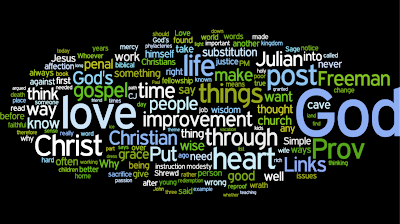
Vanity 'Wordle'ing

I thought it would be interesting to wordle my blog... I wordled the archives for each year. The top is 2005, moving along to the bottom, which is 2008 (so far). It's interesting to note the progression of themes. I like that the things that are consistent, however, are the things I hope to major on in my thoughts and writings.


Some Objections to Penal Substitution

In keeping with our theme of atonement from yesterday, I thought I'd outline some of the more common objections to penal substitution offered in contemporary 'evangelical' literature. Again, these are very brief descriptions of the arguments, but they are simply intended to familiarize us with what is being said by self-proclaimed evangelicals today.

God willing, we'll examine some of the arguments for penal substitution tomorrow, but for now, here are some of the most common contemporary objections to it:

  1. Penal Substitution and Divine Love

  2. Those who hold to this objection argue that God is love (1 John 4:8), and his expression of his character in Christ is ultimately love. With this schema in place, seeing God as wrathful and punitive is clearly out of character, and therefore wrong. The God who would demand penal substitution is a God of vengeance, it is argued, not a God of love. The justice of the God of the Bible is in line with his love and is therefore corrective and remedial rather than wrathful or punitive.

  3. Penal Substitution and Divine Justice

  4. Here it is argued, in connection with the above argument that we have misunderstood divine justice. God’s justice must be interpreted in light of his love. The notion that there is guilt which must be punished is western and modern in its origin, and is far from biblical. God’s justice must be viewed as remedial. Our guilt is better viewed in terms of shame, rather than guilt, and once that is understood we will see that there is no need for a penal substitute to satisfy the wrath of God. Like God’s justice, it is argued that his wrath must be redefined in non-western terms. Rather than an angry response to sin, God’s wrath is seen merely in the natural consequences for sin.

  5. Penal substitution and the Trinity

  6. Here it is argued that penal substitution betrays a wrong understanding of the Trinity. Since, in penal substitution, God the Father would be turned against God the Son (which, it is assumed, could never happen), then penal substitution must therefore be wrong. Any pitting of the persons of the Trinity against each other must be wrong, and therefore penal substitution is jettisoned.

  7. Penal Substitution and Violence

  8. Here it is argued that the notion of God requiring a violent atonement for the sake of forgiving offences and propitiating wrath is entirely distasteful at best, and could well be construed as condoning violence in human relationships as well. For example, it is often argued in contemporary feminist literature that penal substitutionary atonement theories only encourage the abuse of women and children who are innocent, but told they must bear the wrath of their fathers and “bear up” and suffer like Christ. This, they argue, is a far cry from biblical Christianity, and is a reason to deny penal substitution.