Wednesday, June 25, 2008

What's Important to Canadians?

A recent Angus Reid study has revealed some interesting (even if not surprising) things about what Canadians value. Here are a few highlights.

96 per cent of respondents say having enough free time to do what they want is very important or moderately important to them. Achieving career success (89%), volunteering (74%) and having children (72%) are also high on the scale of accomplishments.
Following their religious beliefs (46%), being wealthy (53%) and tying the knot (55%) are not valued as highly by Canadians across the nation.
More men (58%) than women (53%) view marriage as an important part of life.
What to make of this? There are lots of things that could be said, but I'll leave it at this for now: There is a profound irony here.

The trendy emergent crowd says that evangelicals are out of touch, fighting yesterday's battles about things like marriage, feminism, and other family issues. Yet, these seem to be the very areas where our culture needs to be challenged and corrected.

The ironic twist is completed when we notice that most of the excitement in the emerging crowd is directed to issues like social justice (with a high emphasis on volunteering), not being a religious zealot, and fighting against the drive to be rich. Yet, none of these seem to be out of line with what secular people in Canada already think.

While the conservative evangelicals are accused of being out of touch, the hip emerging crowd preaches what the culture wants to hear--and what they already believe. Why would we expect anything else?
I charge you in the presence of God and of Christ Jesus, who is to judge the living and the dead, and by his appearing and his kingdom: preach the word; be ready in season and out of season; reprove, rebuke, and exhort, with complete patience and teaching. For the time is coming when people will not endure sound teaching, but having itching ears they will accumulate for themselves teachers to suit their own passions, and will turn away from listening to the truth and wander off into myths. As for you, always be sober-minded, endure suffering, do the work of an evangelist, fulfil your ministry.

The Blame Game

This summer, while our pastor is on sabbatical, I'll be preaching (God willing) through the book of James. This week I'm studying to preach James 1:1-18. Today, over at the Desiring God blog, they've got a great application of James 1:13-15.

I heartily recommend you check out this post: '12 Sins We Blame on Others'

Here are the 12 sins they list:

  1. Anger
  2. Impatience
  3. Lust
  4. Anxiety
  5. Spiritual Apathy
  6. Insubordination
  7. A Critical Spirit
  8. Bitterness
  9. Gluttony
  10. Gossip
  11. Self-Pity
  12. Selfishness
Blaming others is an easy way to justify self in attempts to remove shame and guilt without even realizing it. May God give us grace to see our sin and accept our sin for what it is... and then flee to the cross!

Biblical Support for Penal Substitution

As promised yesterday, here is what amounts to a super-brief (again) presentation of the biblical support for penal substitution. Despite what the critics will posit, it's not new, it's not western, it's not because of Augustine, and it's not even modern; penal substitution is biblical.

We'll borrow our definition of 'penal substitution' from Wayne Grudem (579):

Christ's death was 'penal' in that he bore a penalty when he died. His death was also a 'substitution' in that he was a substitute for us when he died.
The biblical support for penal substitution is so prevalent throughout the storyline of redemptive-history that it is hard to express with concision. Our approach will be to sketch a few examples of the foreshadowing of Christ’s penal substitutionary work from the OT, and then examine the corroborating evidence from the NT.

The penal substitution of Christ is foreshadowed at least as early as Genesis 22. In this story Abraham is called to offer his son Isaac as a sacrifice to God. When Abraham demonstrates his faith in God by preparing to offer his own sin, God intervenes—surprisingly and miraculously—by providing a substitute; a ram was sacrificed in the place of Isaac, so that he could live. Again, in the miraculous redemptive work of God in saving Israel from their captivity in Egypt, penal substitution is prefigured. On the night of the Passover, the people are to slaughter a spotless lamb (just enough for each household). During the night, the Destroyer would come to take the lives of all the firstborn sons in the land. Only those who were in the homes where the lamb had been slaughtered were preserved; the lamb had died in place of the son. The book of Leviticus (chs. 4-7 indicate specifically the nature of the cultic rites) teaches that where sin has occurred, whether intentional or not, a death must result. Here it is made clear that an animal had to die in place of the human who had sinned, and therefore deserved death. The prophetic writings reflect back to the Israelites the nature of that law, as well as looking forward to the coming of Christ, which is why Isaiah 52-53 portrays the penal substitutionary work of Christ perhaps more clearly than anywhere else in the OT. There it is put bluntly and undeniably: “He was wounded for our transgressions; he was crushed for our iniquities; upon him was the chastisement that brought us peace, and with his stripes we are healed” (Isaiah 53:5).

The NT evidence is no less scarce. In fact, one approach to displaying the NT evidence is by a simple study of the preposition huper (ὑπερ). It has been argued that huper has a simple meaning of “for one’s benefit.” When studied in individual passages, however, it has been demonstrated that there is a much stronger meaning contained in the word, which may be explained as “for one’s benefit, by being in one’s place.” This stronger meaning is evinced in the following passages. In John 10:11, Jesus teaches that he is the Good Shepherd who lays down his life for the sheep. The very nature of the metaphor requires the stronger meaning. Similarly, in Galatians 3:13 we are told that Christ redeems us from the curse of the law by becoming a curse for us. This simply cannot mean only “for our benefit”; in this instance it is clear that he becomes the curse in our place, that we might benefit. Again, 1 Peter 3:18 states that the righteous one suffered for the unrighteous, which clearly indicates that we receive the benefit only by having a substitute. Aside from the meaning of huper, a plain reading of passages like 2 Corinthians 5:21 (where Christ was “made to be sin” on our behalf) and 1 Peter 2:24 (where Christ “bore our sins in his body”) militate against any argument that penal substitution is unbiblical or unnecessary.

Tuesday, June 24, 2008

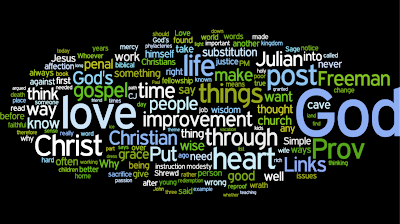
Vanity 'Wordle'ing

I thought it would be interesting to wordle my blog... I wordled the archives for each year. The top is 2005, moving along to the bottom, which is 2008 (so far). It's interesting to note the progression of themes. I like that the things that are consistent, however, are the things I hope to major on in my thoughts and writings.


Some Objections to Penal Substitution

In keeping with our theme of atonement from yesterday, I thought I'd outline some of the more common objections to penal substitution offered in contemporary 'evangelical' literature. Again, these are very brief descriptions of the arguments, but they are simply intended to familiarize us with what is being said by self-proclaimed evangelicals today.

God willing, we'll examine some of the arguments for penal substitution tomorrow, but for now, here are some of the most common contemporary objections to it:

  1. Penal Substitution and Divine Love

  2. Those who hold to this objection argue that God is love (1 John 4:8), and his expression of his character in Christ is ultimately love. With this schema in place, seeing God as wrathful and punitive is clearly out of character, and therefore wrong. The God who would demand penal substitution is a God of vengeance, it is argued, not a God of love. The justice of the God of the Bible is in line with his love and is therefore corrective and remedial rather than wrathful or punitive.

  3. Penal Substitution and Divine Justice

  4. Here it is argued, in connection with the above argument that we have misunderstood divine justice. God’s justice must be interpreted in light of his love. The notion that there is guilt which must be punished is western and modern in its origin, and is far from biblical. God’s justice must be viewed as remedial. Our guilt is better viewed in terms of shame, rather than guilt, and once that is understood we will see that there is no need for a penal substitute to satisfy the wrath of God. Like God’s justice, it is argued that his wrath must be redefined in non-western terms. Rather than an angry response to sin, God’s wrath is seen merely in the natural consequences for sin.

  5. Penal substitution and the Trinity

  6. Here it is argued that penal substitution betrays a wrong understanding of the Trinity. Since, in penal substitution, God the Father would be turned against God the Son (which, it is assumed, could never happen), then penal substitution must therefore be wrong. Any pitting of the persons of the Trinity against each other must be wrong, and therefore penal substitution is jettisoned.

  7. Penal Substitution and Violence

  8. Here it is argued that the notion of God requiring a violent atonement for the sake of forgiving offences and propitiating wrath is entirely distasteful at best, and could well be construed as condoning violence in human relationships as well. For example, it is often argued in contemporary feminist literature that penal substitutionary atonement theories only encourage the abuse of women and children who are innocent, but told they must bear the wrath of their fathers and “bear up” and suffer like Christ. This, they argue, is a far cry from biblical Christianity, and is a reason to deny penal substitution.

Monday, June 23, 2008

On Momming, part 2

My brother (over at his newly up-and-running blog) has a rather comical (and incredibly geeky) version of my 'on momming' post. You can read it here.

Maybe it's just funnier for me because I can actually envision the whole thing. Or maybe I can just envision it because it could very well have been a description of life in my house instead of his!

The Atoning Work of Christ

It is a charge often brought against those who hold to penal substitution that we miss the dynamic presentation of the atoning work of Christ through Scriptures. In other words, if you hold to penal substitution, you miss the many ways that the Bible speaks about the atonement.

I've had some opportunity lately to think through the atonement, and I believe that this charge is patently untrue. As one who holds firmly to the notion that penal substitution is at the root of all benefits that come to us through the cross of Christ (biblically and historically), I still am able to see that the picture of Jesus' cross-work is not monolithic.

In an effort to flesh this out, and show that this charge is incorrect, here is a super-brief examination of six facets of the biblical presentation of the atonement aside from penal substitution.

  1. Sacrifice

  2. The storyline of Scripture is replete with examples of sacrifice, not all of which carry notions of penal substitution. The concept of Christ as “the Sacrifice of God” picks up on these sacrifices and proclaims Jesus to be the ultimate antitype. Examples would include Noah’s post-flood sacrifice, the averted sacrifice of Isaac, the various prescribed sacrifices in the Old Testament law, and many others. Christ as the antitype of the sacrifice theme in the Old Testament is picked up clearly by John the Baptist, who proclaimed “Behold, the Lamb of God!” (John 1:36; all Scripture quotations from the esv). This theme is developed most prominently in the book of Hebrews, particularly in chapters 5-9. In chapter 9, Christ is seen to be the antitype of all the “bulls and goats” as he accomplishes salvation as a sacrifice for his people, in the eternal holy place (vv. 11-27). As Hebrews 9:26 sums up, Christ came “to put away sin by the sacrifice of himself.”

  3. Redemption

  4. Redemption is another theme which runs through storyline of salvation-history. God’s people are, at various points, seen to be slaves or captives who must have their freedom purchased at a price. So, the Israelites needed to be redeemed from slavery in Egypt, then the laws for the redemption of individual slaves are established through the Torah, and then finally, when Judah is in exile in Babylon, God must accomplish her redemption to bring her home. This theme is ultimately fulfilled in Christ, through whose work we see that the redemption price must ultimately be paid to God, not to any human oppressor. It is God who is offended by our sin, and therefore, the price of redemption must be paid to him. Hebrews 9 draws out the fulfilment of this theme, saying that the “blood of Christ, who through the eternal Spirit offered himself without blemish to God” (v. 14) is what has secured our “eternal redemption” (v. 12). Through his death, Christ has inaugurated the new covenant, in which his people may receive the “promised eternal inheritance, since a death has occurred that redeems them” from their transgressions (v. 15). The basic idea of redemption is that the world is in bondage to sin and Satan (1 John 5:19), but Christ came to offer his life as a redemptive ransom (Mark 10:45).

  5. Propitiation

  6. Interestingly, Romans 3:24-25 links the redemption accomplished in Christ with the propitiatory nature of his sacrifice. Propitiation carries the notion of God’s righteous wrath against sin being fully borne out on another. In the context of Romans 3, then, as Paul has said (vv. 5-6), God is indeed righteous to inflict wrath on us and the condemnation of all is justly deserved (vv. 8, 19, 23). In fact, it was for the very purpose of displaying his righteousness that God showed himself to be both just and the justifier of the ungodly when he put forward Christ Jesus “as a propitiation by his blood” (vv. 25-26). God’s propitiation of his wrath against sin and sinners in the atoning death of Christ Jesus, then, is intrinsically tied up with the display of his justice and righteousness, as he declares the guilty innocent; the wrath they deserved was justly poured out on the substitute. Hebrews 2:17 declares that Jesus’ had to be entirely human in every respect so that he could justly become the propitiation for the sins of humans. 1 John 4:10 also states that the love of God is shown in this: that Christ was sent to become the propitiation for our sins.

  7. Reconciliation

  8. There are three aspects to reconciliation. First, there must be a present relationship of estrangement / alienation / hostility between persons. Second, an intervention must be made to remove the basis of the estrangement. The third stage is a renewed relationship of peace, love, and acceptance between those formerly estranged persons. The biblical doctrine of reconciliation begins with the understanding that we have sinned against God, and that he is the alienated party. That is why Paul can plead with sinners to be reconciled with God (2 Cor 5:20). The reconciliation that takes place is accomplished by God, in Christ, who initiates reconciliation, even though he was the offended party (2 Cor 5:18-19).

  9. Christus Victor

  10. The doctrine of Christus Victor states that Christ’s work (death—resurrection—ascension) indicates that he has taken on death, sin, and Satan, and has emerged from the battle as a victorious conqueror. It is based on texts such as Colossians 2:15 and Hebrews 2:14-15, which state that Christ has destroyed the one who has the power of death and delivered all those who through fear of death were subject to slavery; he has disarmed the rulers and authorities and triumphed over them. While the doctrine of Christus Victor is often pitted against the doctrine of penal substitution, it is actually a result of Christ’s penal substitutionary work, and the two doctrines must be held aright in view of each other.

  11. Christus Exemplus

  12. Similarly, the doctrine of Christus Exemplus is sound only when kept in perspective by a right understanding of the justifying and propitiating work that Christ accomplished on the cross. This doctrine teaches that Christ, in his suffering, became a perfect model for us of how we are to live and to suffer, entrusting ourselves to God. This is based on passages such as Philippians 2:5-11 and 1 Peter 2:18-25. We are to follow Christ and become like him in his sufferings, taking up our cross daily; but we must bear in mind that the primary intent of Christ’s cross-work was first and foremost to propitiate God’s wrath, accomplishing salvation, and then derivatively it serves as an example for us.

Thursday, June 19, 2008

Rejoicing in Four Years of Grace

Today I am rejoicing. Stacey and I are celebrating our fourth anniversary this very day. As I look back over the four years, I have to marvel at God's grace... in so many ways!

On this anniversary I'm rejoicing in God's grace in these three ways in particular:

  1. God looked at me, liked he looked at Adam, and said, 'It is not good for that guy to be alone.' I could not possibly agree more! The Lord provided a bride for me--out of all men, the most undeserving. Bone of my bone, flesh of my flesh. She has become one with me. She is my partner, my friend, my lover, my helper, my companion, my counsellor. She listens, she shares, she opens herself up to me, and she lets me open up my heart to her. I am grateful for God's grace in giving me my wife. I couldn't do 10% of what I do if I didn't have her.

  2. God has preserved our marriage through his love and by his grace. Love keeps no record of wrongs. Love hopes and believes all things. That's God's love... and it's been poured out into our hearts and into our marriage by the Holy Spirit through the example and work of Christ. This is amazing... and so needed! Maybe other husbands are just better husbands than me, but I don't see how any marriage could last without the love of Christ, present and active. I have needed my wife to forgive me countless times. I have needed her to continue to open her heart to me time after time when I've hurt her or let her down. She's never failed, because of God's grace. Her love for Christ is powerfully evident in her faithful love for me, no matter how many times I mess up. I am thankful to God that my wifes 'hopes all things' and 'believes all things' for me now, even more than she did four years ago today. That is evidence of God's grace, and so I'm thankful to God for my bride.

  3. My wife has grown in beauty. Over the five years that I have known her, I have watched Stacey grow in remarkable ways as she seeks to live in 'respectable and pure' ways. She has worked hard to make sure that her adorning is not external, but is an 'imperishable beauty' of the inner person, which is precious in God's sight--and a husband's! She has been a faithful testimony to me of God's Spirit active and working in the heart of a woman... and that is a beautiful thing indeed. And on top of all that, she has flourished in external beauty as well. How could I have imagined that? I don't know... but it sure makes me look forward with great anticipation to our fiftieth anniversary!
So, Stacey, thanks for four wonderful years. Here's to many, many more!

Friday, June 06, 2008

Randoms

It's hard to know sometimes what to blog about when there are so many different things going on in life. Here's a few things I've been thinking about.

Humility
I've thought about this on this blog before, but I was blessed with the opportunity to teach on it recently at a men's meeting at our church. The more I look into my heart, the more it seems the Lord is pleased to reveal to me the hideousness of my own pride-filled, arrogant heart. You can download the pdf of the handout and application questions I gave to the guys here, if you like.

Letting Others Serve
It's a funny thing, but you'd think that not wanting others to serve you would be a sign of humility. As I've been noticing in my own heart lately, though, it's more a sign of pride. Why don't I want others to help? For one thing, because I don't want anyone to think I need help. CJ says part of pride is refusing to acknowledge our absolute dependence on God. I like to think I'm self-sufficient. That's pride.

Another thing I've been confronted with a few times now is other people wanting to take over jobs for me, since I've become an elder at church. They want to employ biblical wisdom and free their elders up from other tasks so that we can focus on the word and prayer. But I don't want to give these things up. Why? Because somewhere in my heart I feel like I do a good job at what I do and if someone else were to do it, they wouldn't do it just the way I like it. Well that's a load of hoogly. Just because something's the way I like it doesn't mean it's best. And in reality, they'd probably do it way better than me anyway! What's best for the kingdom is me moving aside and letting others serve.

Leadership Can Be Nerve-Wracking
We're in what's probably the busiest time of year for the leadership of GFC--annual meeting time. We're looking at numbers, praying through plans, and discussing endless possibilities for future directions. This is my first year as an elder working through these things. Whenever I begin to think that any of these things--and therefore the welfare of the church--depends on us, as humans, I get stressed, worried, and fretful. This has been a good exercise for me in learning to pray things through, and trust Christ to build his church. I am learning (painfully slowly, but learning nonetheless) to trust in the Spirit to give wisdom. I am learning to trust the Father's providence. He has given us much responsibility, and we will be held accountable for our leadership, but the worst mistake we can make is thinking that it all depends on us and our wisdom, and then forge ahead un-prayerfully.

Monday, June 02, 2008

How Big Are Your Phylacteries?

What are phylacteries? They're the Greek word used for Tefillin. Not helping? They are boxes with straps that the Jewish people have made for millennia. They contain pieces of Torah and are worn on the arms or foreheads.

Where would they get an idea like this? Try looking up Exodus 13.9, 16; Deuteronomy 6.8; 11.18.

Each verse on its own, isolated from its context, could be taken in such a way that these Tefillin could be defended. More fitting, however, is the idea that the Lord is calling his people to preach to themselves and their children. His word is to be so central to their thoughts, meditations, and conversation that it would be as if they have the word bound to their foreheads--you can't help but notice it! To run into one of these people is to come face-to-face with the Law.

As I've said before, what excites you is what you pass on. God is calling his people to show their passion for his righteous Law.

When it comes to phylacteries, one could make the case that they are legitimate, even as physical things. But they were to be peripheral things, not central.

What did Jesus think of phylacteries? Well, he mentions them in Matthew 23.5, in condemning the religious leaders of his day. In that case, Jesus was condemning their actions because they had taken a peripheral, non-necessary element of their faith and made it central. They had made it a show. It wasn't enough to rejoice in the Law like all the rest of God's people--they had to figure out something extra that they could do to make themselves stand out from the crowd. They wanted to show themselves as different and better in some regard.

The temptations to do this in the Christian life are legion. As Don Carson is wont to say, 'It is easy to sound prophetic from the margins; what is desperately needed is to be prophetic from the centre.' What he means is simple. It is easy to make yourself seem more spiritual, more noble, more informed, more mature than you are by dealing with side issues. It makes you look like you're further advanced. If you're forever preaching about things that others hear and say, 'wow, I hadn't even thought about that...', then it makes you seem like a prophet. You are exalted.

What I want to suggest is that in the Christian life, our pet issues will often become our phylacteries; the extra things we add on to the centre of the Christian faith to make ourselves seem further advanced in Christian living than we are. They make us stand out in a crowd of 'normal Christians.'

As Christians who know the gospel, it is always a temptation to assume the gospel. When that happens we exalt secondary (or even tertiary) issues to levels of primary importance, and determine levels of standing within the church based on our pet issues (our phylacteries), rather than our faithful love for and proclamation of the gospel.

What kinds of things do Christians make into phylacteries? How about new books that you've read / are reading? Understanding all issues of deep theology, or being the first to discover some hip 'new' theology that no one at church understands yet. For many in our day it is social justice or 'ministering to the community at large.' For some it is on-demand breast-feeding, while for others it could be scheduled feeding. Many Christians get caught up with new diets or types of food that they swear will make all the difference. Some Christians make a career out of arguing for home schooling, Christian schooling, or public schooling. The list could go on and on! All this is not to say that these are bad causes, but it is to say that we need to fight with everything in us to make sure we're known first and foremost for loving the gospel (like we wear it on our foreheads!), not for being some social justice advocate, or some home-school promoter.

What Carson has said is true, that it is easy to sound prophetic from the margins. What is most concerning about this, however, is that Jesus says pride is living in these attitudes and working through them. Pride destroys opportunities to be workers for the kingdom, since Jesus himself says 'Whoever exalts himself will be humbled.' God opposes the proud. You're not working for the kingdom if you're promoting another cause more than the gospel.

The second part of Carson's quote is equally true: 'What is most needed is to be prophetic from the centre.' You can't do that when you're shouting from the peripheries. The gospel gets drowned out. If we're always known for being passionate about secondary issues, how will we ever be able to express that we're more passionate about the gospel?

So how about you? What are you known for? What do people see on your forehead and arms? Is it obvious to those who know you that the gospel is your first love and primary passion?

It is my prayer that my phylacteries would shrink; that I would speak boldly and passionately about the gospel, and never be more passionate about anything else than Christ and his love for me. I want to be slow to express my opinions on secondary matters. I want to be known for loving what all Christians are called to love: the gospel. Never some other cause.

Thursday, May 29, 2008

On Momming

The things in life that we are most prone to take for granted are generally not the things we should take for granted. The things we presume on are usually not those things which are ordinary, but rather, the things which we most regularly see.

The funny thing about what we most regularly see is that it becomes what we actually notice the least. When you see a friend's kids everyday, you don't notice how much they're growing and changing, but when you don't see them for a long time, you notice every little change. What I see the most is what I tend to notice the least.

In my life, the place I spend most of my time is at home. As a student, I do most of my work from my desk at home. Since our church has no official office, my desk functions as my office for my job as well. All this combines to make me a genuine homebody (though I'm not as bad as Tim Challies... rumour has it he was born with quite a dark complexion, but has only turned pasty over the past 185,342 consecutive days of blogging).

In my world, then, the things that I am most likely to not notice are the things that happen at home, since it's where I spend most of my time.

Here's one thing I take for granted all the time, that I never should: my wife works hard.

Stay-at-home moms get a bad reputation in lots of circles, but let me tell you, it is a hard job. All the worst aspects of all the worst jobs are combined in this one. Low (no) pay. Repetitive tasks. Very little by way of immediate results. Everything you do needs to be redone in a few hours, tomorrow, or next week. You're forced to multi-task in ways that no human should ever be able to multi-task. No one appreciates you. No one sees the work you do. There is very little by way of intriguing conversation over the course of a day. Loud noises and crying that would drive anyone else nuts in about five minutes are your background music. There is almost no imposed structure on your day (which is bad for scatter-brained people like myself who need order). The hours are long and irregular. When everyone else takes vacation, it only means more work for you. Your job is literally never done. Then a husband wants dinner, time together, and then romance at night when you're ready to fall over you're so tired.

Then whenever you're at dinner parties or meeting someone new they ask, 'What do you do?' You answer, and they say, 'Oh...'. Who has it harder than all this?

I see it everyday, but how often do I notice it? More often than not I take it for granted. I think my busy-ness means it's okay to let her work hard and be busy too. I think it gives me an excuse to presume on her work. I think that she should be able to handle it... she always does, right? I end up taking for granted the very one whom God has given me to enable me to do my ministry. I could accomplish nothing without her, but how often do I stop to think about that and thank her? Or better yet, help her?

I am a slow learner. I hope that you men who read this are not as slow as me.

Honour your wife. Tell her how she's a blessing to you. Explain to her how you see God's grace active in her life. Point out the fruit that God is bringing about through her labours. Encourage her with a note or a written prayer for her. Speak highly of her ministry to others. Look for new ways to help her with her job. Care for her as you would your own body. Kiss her, tell her you love her. Do something... do anything! Just don't take her for granted.

In doing this, you'll be valuing what God values, and thus, he will be honoured as you honour the one who is your glory.

Wednesday, May 28, 2008

How Simple and Shrewd Viewed Sage

I wrote this a few years ago for a different forum. I thought I might as well post it here as well. Hope you enjoy!

--------

In a place far from here three men, each on a pilgrimage met each other as they were travelling down a forlorn path. Conversation quickly revealed that the three were all desirous of reaching the same destination. One was an old man named Sage who said he had himself carved these paths many years ago. The second man was Simple, a smithy by trade, who often seemed quite pliable. The third man, a young noble named Shrewd, was wise in his own eyes and often desired to forge new paths, even as he imagined Sage had done when he was young.

As the three travelled on for some days, Sage offered direction time and again as he led them through grounds neither of the younger men had seen before. Every time he provided direction, no matter how unlikely it seemed, his word proved to be true and they found themselves to always be headed in the right direction.

Eventually, when the two young men awoke one morning, they found Sage already dressed for travel. He informed them that he had to depart for some time, but that if they followed his directions, he would meet them at the end of their journey. After some days on the path, he said, they would come to a cave. Despite what they saw, no matter how difficult the path through the cave would become, they were to keep going and not give up. This was the only route, he warned, that would take them to the land they desired.

Sure enough, after two days of walking, Simple and Shrewd found themselves at the mouth of a cave. Shrewd took a good long look at the cave, examining it from various perspectives. He warned Simple that caves such as this had been found to be perilous traps before for clueless pilgrims. Simple, however, was convinced that this was the cave he had been told they would find. Seeing that Simple would not be swayed, Sage reluctantly said he too would enter, but that Simple must go first.

As they entered the cave, they found that it travelled only down. Further and further it went, and the air got increasingly frigid. Soon it was totally black and both Simple and Shrewd were in despair for their lives. Looking ahead as far as he could, evaluating the little of the contours of the cave his eyes could discern, Shrewd began to speak:

'Simple, this is all wrong. Anyone with a half a brain knows that a cave which leads to open land lets in light from both ends. If it is day time outside, and there is a way out of this cave, then we would be able to see light. It makes sense. To follow this path any longer is illogical. We can see that with our eyes. If you insist on staying here anymore, you will have to go it alone, because wisdom advises me to turn around.'

Simple reasoned, 'The man Sage has never lied to me. He has led me safe this far, and even his words about this cave proved true; the way is difficult. Would it not be more foolish now to turn back, having seen that his counsel has been good thus far?' And so he spoke to Shrewd, 'I cannot see the light we both know we should see. But I know the man Sage, and I trust him. I will not turn back.'

So Shrewd and Simple parted ways.

Shrewd quickly, since he was moving towards the light, found his way out. Once out into the forest again, he surveyed the land, checked his compass, and headed off to forge his own path; to take the road less travelled and make his own mark. Not a mile from the cave, as he was looking at his compass, thinking hard about which way made the most sense to him, he happened to walk in between a family of bears, separating a mother from her cubs without even knowing it. He was mawled, and there he died, compass in hand, never having reached his desired land and never having carved the paths he had wanted.

After Shrewd left, Simple continued slowly through the cave. Shortly he had to feel his way along with only his hands as his sight completely failed him in the dark. Several times he hit his head or stubbed his toe, and many times he even began to question whether or not Sage's words had been correctly spoken--or perhaps they had been misunderstood on his own part? He was, after all, an unlearned man.

But after some time of following the dark, damp, cool walls of the cave, Simple noticed that the wall on his right side disappeared and he realized that he was at a corner. Turning the corner, he caught a glimpse--could it be?--just a glimpse of light ahead. The more he walked toward it, the brighter it got, until he was finally able to walk with ease.

Coming out the other side of the cave he found his old friend, Sage to guide him the rest of the way home to the land of rest he had always desired.

Tuesday, May 27, 2008

Parenting and My Heart

Sometimes it's good to do what's counter-intuitive. In fact, I've found that the longer I've been a Christian, the more I need to second-guess and examine every motive. Sure enough, there is deep-rooted sin in there somewhere. I've found God's evaluation of humanity in Gen 8.21 ('the inclination of their minds is evil from childhood on') to be absolutely correct in my case every time I'm willing to consider for longer than 23 seconds.

This examining and cross-examining of motives and actions is almost nowhere more necessary than in parenting. What can on-first-blush appear to be 'for the baby' can really be simply for my immediate gratification ('I made her feel nice, now I feel better about my ability to parent'). What is really sad about this, though, is that what is often for my immediate gratification as a parent will more often than not be to the child's long-term harm.

So, for example, we're in a store and Susie really wants something, but I already told her she can't have it, I had not planned on buying it, we haven't budgeted for it, and she doesn't need it. What do I do as a parent? The ball is only $1.99 or something silly like that. She is sad if I don't get it. She's happy if I get it. Why not just 'make her happy' and get it? Wouldn't it also make me happier to just buy something for my daughter that I know will make her happy?

Because we teach by example, I'm teaching Susie something in that situation when I give in and buy it. I'm teaching her that it's okay to make unplanned purchases, on an impulse, whether you have the money or not. I'm teaching her that when you complain and fuss in life, you get want you want. I'm teaching her to look for happiness in 'stuff' that can be purchased. I'm teaching her that it is okay to strive against an authority. In all these ways I'm doing my daughter tremendous spiritual harm by 'making her happy' in that moment.

If that's true--and I know it is--then why would I give in to her? Why would I cave when she has a fit? Why would I leave her undisciplined when she breaks rules? Why would I let her go to bed late, get up early, eat what she wants, etc., when I've thought it through and prayed it through ahead of time? Why would decisions that my trusted counsellor (my bride) and I have talked through at length be discarded in a moment?

Because I love my daughter? Far from it. That's the opposite of love.

Why would I be willing to 'do whatever it takes' to stop our baby from crying and make her 'happy'? Because the inclination of my heart is evil from my childhood on. Because my heart is desperately wicked and deceitful above all else and I cannot understand it. Because my near-sighted selfishness is willing to sacrifice the long-term spiritual welfare of my child for the immediate gratification I get from feeling like a good parent; or maybe so that I can congratulate myself on how gracious I am.

I believe it. Now all I need to do is continue to preach it to myself as I make the moment-by-moment decisions I need to make in parenting. God give me grace to be faithful!

Monday, May 26, 2008

Rich Man's Vacation

Well this afternoon I'm back in the office, sorting through e-mails and trying to figure how to begin catching up after two weeks of vacation. The highlights were (among other things) a trip to DC to visit Covenant Life Church, and a trip to the cottage this past weekend.

More than just doing stuff though, this vacation was great because I got to spend time with my family. In a song called 'Home', Paul Brandt says 'Time just flies no matter what you do.' That's true. Especially when your kids are as young as ours are. I can't believe how quickly they change. What a blessing to be able to have this time with them!

And then there's my amazing wife. Stacey is so patient to put up with me and my schedule. Without a doubt one of the things in life that never ceases to amaze me is how my wife can just keep going, doing job after job (though it's more like job-during-job, piled on top of job) around the house, and with the kids, yet she always seems to be able to do it well and do it with grace. She ministers to me in amazing ways, even though our schedule doesn't allow me to be able to spend as much alone time with her as we'd like. So this vacation was a blessing in that regard as well.

I'll post a few pictures from the vacation below, after the words of one of my favourite Paul Brandt songs. While our house is not 'run down' and our bills have yet to 'pile up', I can totally identify with what he's saying.

Rich Man
I look in the mirror, don't see much
Fashion sense a little out of touch
The house is run down as the bills pile up
But I'm a rich man

Breakfast table, morning rush
Sometimes it seems we barely have enough
But if it's true that all you need is love
Then I'm a rich man

When she smiles or they call me Daddy
All the worries of the world just seem to fade away
I'm alive and I know what matters
If this is all I ever have
Well, that's ok
'Cause I'm a rich man


So every morning, and brand new day
With each and every single breath I take
I'm blessed and I'm thankful, yeah I've got it made
Oh, I'm so glad life turned out this way

I've loved, I've been loved,
Show me someone else with as much as me

Yeah, I'm a rich, rich man
Yeah, I'm a rich man
Oh, I'm a rich man
I've got it made
What matters, what matters
I know what matters
Oh, I'm alive


Friday, May 23, 2008

Don't Believe Them

When people tell you that families are a drag, that kids are a sacrifice, that it's too much work, or that you should wait and have fun before having kids... don't believe them.

We're heading to the cottage this morning, so I just thought I'd post some pictures from a couple of our cottage trips last year. Nothing but delighting in God through the bounty he's given us. What an amazing blessing to have a family that enables you to worship God better! What a wonderful end to our vacation.