Gone
My friend Tim and I are leaving this morning to attend WorshipGod06, put on by Sovereign Grace Ministries. I don't know that I'll be blogging at all while I'm gone, but check Tim's blog for regular updates as he live-blogs all the goings-on.
.jpg)
My friend Tim and I are leaving this morning to attend WorshipGod06, put on by Sovereign Grace Ministries. I don't know that I'll be blogging at all while I'm gone, but check Tim's blog for regular updates as he live-blogs all the goings-on.
Kerux sounds in with some important thoughts--well worth the read. Enjoy!
Mainline Christianity is Dead: And Why that is A Good Thing
I have had the privelege of filling the pulpit at Grace Fellowship Church for the past few weeks while 'the preacher' (aka kerux) was away on vacation. The past two Sunday nights I tried to draw some more practical thoughts together with regards to poverty of spirit (see here, here, here, and here for the series I started, and to which I hope to return shortly).
This message's title was 'From Poverty of Spirit to Riches of Wisdom.' The basic premise is that if we are broken before God, we will be humble before others (poverty of spirit) and that this will result in true life change (ie. wisdom: the ability to live skillfully, in a way that pleases God in the midst of a fallen world). In order to live wisely, we must be humble.
Here's the outline:
This is the last installment in this series, unless I stumble across something pretty amazing. This time I want to point out that two of our most famous (and deserving so!) hymns that we've sung in our churches for years are missing verses. Since the hymns are so popular I won't post all the verses, just the ones that are usually missing (how's that for irony?). If you want to see all the words, check here and here.

Ken wrote this hymn at a time when the established church believed only Scripture should be sung as hymns, with an emphasis on the Psalms. Some considered it sinful and blasphemous to write new lyrics for church music, akin to adding to the Scriptures. In that atmosphere, Ken wrote this and several other hymns for the boys at Winchester College, with strict instructions that they use them only in their rooms, for private devotions. Ironically, the last stanza has come into widespread use as the Doxology, perhaps the most frequently used piece of music in public worship. At Ken’s request, the hymn was sung at his funeral, fittingly held at sunrise.
Here are all the great words. It is a song we would all well be able to use in our morning devotions, even now, 330-some-odd years later. Enjoy!
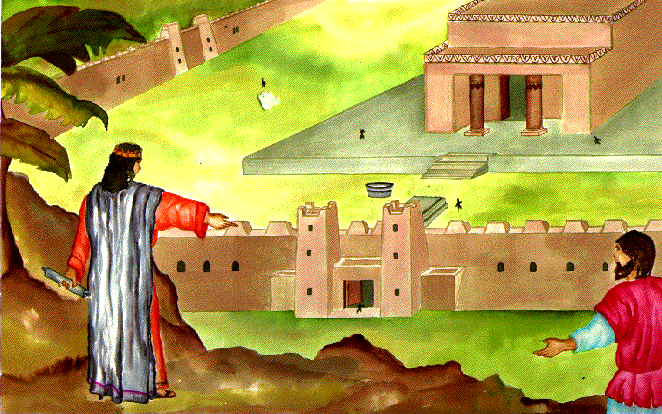 Yesterday I got to read through a portion of 1 Kings. My favourite part of what I read was Solomon's building and dedication of the temple. After reading from Genesis all the way through to 1 Kings, it is a wonderful breath of fresh air!
I think sometimes we lose sight of just how momentous an occasion this really was. Finally... after slavery, the exodus, the 40 years of wandering, the failed conquest of the promised land, the pathetic time of the judges, the first king becoming a miserable failure, a lifetime of war and tumult under David... finally, peace! Finally, God's people are able to construct a permanent fixture where God will be honoured and worshiped. It is the place where he has chosen to make his name dwell. So Solomon has construction of the temple completed, he brings in the ark of the covenant, and offers his prayer of dedication. It's a wonderful scene of celebration and worship of our God as innumerable sacrifices were offered. God is pleased to come down and dwell in his temple--so much so that the priests could not stand to minister in the Holy Place because the glory of YHWH filled the house.
The temple is the place where God dwells and where man can meet with him--the place where God and man dwell together. It is the place where God's glory abides, where he reveals himself to his people.
Solomon's prayer of dedication is then largely concerned with the request of God that whenever God's people pray toward this temple--where God and his people can meet together, where God himself dwells--these prayers will be heard and answered. This is to be true, even when they have sinned, this will be the way they are to pray for reconciliation--pray toward the temple.
And so Solomon, the king, prays for his people. He intercedes for them before the Lord, pleading with God that their sins will be forgiven and that he will have mercy on them.
The glory of God had descended on this place, the Lord had met with his people and heard the prayers of Solomon--why? All of this is made possible--God's people can approach God in his temple--because of the sacrifices they had made. They sacrificed before the ark as they brought it in, and once Solomon had prayed they offered more: 22,000 oxen, and 120,000 sheep as peace offerings to God.
But all of this was still imperfect, in some sense, because we see that where the holiness and the glory of God dwell, the priests still aren't able to be. After a while, the priests are forced to leave the Holy Place where they ministered because of the presence of God.
Of course, what I love the most about all this is Jesus. Where was he? Where wasn't he?! Jesus is the temple--the perfect meeting place of God and man. In him the fullness of deity dwells bodily. He said, 'destroy this temple and I will raise it in three days.' But of course, he was not referring to the temple of stone, but the temple of his flesh--where God and man truly come together. And because he is the fulfillment of the temple, he's also the reason our prayers are offered freely to God now, because we pray through Christ.
But Christ is more than the temple and the reason our prayers are heard. He's also the true Solomon--the true Son of David who will inherit the eternal throne and promises of God. As the true Son of David and the true King, Jesus is the one true intercessor for his people! Now he offers prayers to God on our behalf!
And of course, Jesus is the true sacrifice which makes God's meeting with his people possible at all. Jesus is the perfect 'once for all' sacrifice for the sins of God's people, that every single one of his people would be perfectly covered and able, finally, to meet with God.
And lastly, it has all been made perfect now, through Christ, because we no longer have to worry about imperfect priests, unable to draw near in the earthly temple, because the earthly temple was only ever 'copy' and a 'shadow' anyway! Now, Christ, who is the true high priest, draws near to God in the perfect, heavenly temple on our behalf.
I could go on and on, but this is too long already. What an absolutely wonderful God! What a wonderful Saviour! What a wonderful book that ties all these things so beautifully together. No wonder Christ said he's the fulfillment of the whole thing! He well deserves the name that is above all names.
 I've gone back and forth a bit on this issue, so if you've thought about it, I'd love some input. Here's the question: How much value is there in other world religions? How much time should we spend studying them? When we study them, how should we study them?
Before I went to college, I was of the mindset that there was very little value in getting to know other religions in a meaningful way. For good or for ill, by the time I was done at Heritage, I had come perilously close to being convinced that we needed to know other religions. Buddhists were asking better questions than Christians. Many Muslims are more devout than Christians. World religions like Hinduism, Sikhism, even the Bha'i people, had accumulated great wisdom over the centuries, and Christians would do well to learn from them.
Or would we? Once out of that environment, I began to realize that there were some serious inconsistencies in the ways that I thought. My good friend Rielly had taught me some about the import of the noetic effects of sin (the effects of sin on the mind). My belief in the doctrine of original sin and mankind's total inability also seemed to be at odds with finding wonderful positives in godless, man-made religions.
Today I was pondering a little bit more what exactly I believe with regards to elements of truth in other religions, and how we should react to / interact with them, and I got to thinking about the Bible.
Obviously, things are pretty clear in the Old Testament. God was straight-out against his people having anything to do with the godless nations around them. But much of the crowd at my college seemed (if not always with words, then with attitudes and hermeneutics) to dislike this 'God' and this 'ethic' of the Old Testament and were very happy to proclaim that we have advanced far beyond that type of thing now. So what about the New Testament?
This is where I got stuck. We have Paul's interaction with the pagan philosophers on Mars Hill in Acts, which seems to be the thing that everyone seems to appeal to in order to make their point on this topic. Remarkably, everyonse seems to have their own take on his this interaction should impact our interaction with other religions and our apologetics today. I'm wondering: what other New Testament texts do we look to here? What texts have you found helpful?
What about Jesus? Many emerging-types like to claim that they are 'red letter Christians', not 'Paulians', so we should deal with Christ. They claim that his harsh words were always for the religious hypocrites (Pharisees), never for anyone else. But it seems to me that Jesus would often use the 'Gentiles' / 'nations' (ie. 'pagans') as a negative example. In other words, 'Don't worry, because that's what the pagans do.' Or, 'Don't just love your brother, because that's what the pagans do.' Am I wrong? It would appear that Jesus felt free to hold up the false religions as examples of godless 'morality', whose standards and thoughts ought to be avoided at all cost. As I said, I've gone back and forth on this, so I am open to being wrong again. If you've thought about this already, please advise.
 I don't know why, but for some reason over the past couple of decades it has become trendy to only sing parts of songs. It makes no sense. How can you follow any kind of flow of thought when you're taking chunks out of the middle? You're destroying an artist's work and ripping the people off by not engaging their full minds in all the depth of the meanings of the songs. But I won't go on and on about it, because Tim Challies blogged on this more ably already (see here) from some experiences he had before coming to our church.
All I'll do here is show you one example that I just aboslutely don't get. Most people know the song I Stand in Awe by Mark Altrogge. But here's what blows my mind: Almost no one knows that there are two verses! Why don't people sing the second verse? I have no idea! It's awesome! Here are the words so you can see for yourself.
And if you lead services at your church, sing both verses! If you don't, then tell your pastor that you should sing both verses... please! :)
Everyone should know by now that I love our church. I've written about it elsewhere.
Interestingly enough, the more we grow with each other at Grace Fellowship, the more I realize that we're all weak. It's fantastic to be a part of an authentic church. As people grow in maturity as Christians and in love for one another in Christ, they begin to feel increasingly open to sharing weaknesses and struggles.
Now, I think there are two ways to mess this whole thing up. Churches usually err either by (a) all pretending that they don't struggle with anything, or, (b) all airing their dirty laundry and end up just glorifying and justifying their sin.
In my estimation, it seems that much of the North American church has been caught up in the former for some time now. As a reaction, the emerging church has swung the pendulum to the latter. It has now become trendy to slam myself and talk about what a pharisee and hypocrite I am. I'm supposed to use as many self-deprecating remarks as I can to show the world that I'm more humble than any of those 'conservative evangelical', pew-sitting, hymn-singing, non-arts-loving types.
The result of course is a bunch of people sitting around saying, 'Well, I'm as much of a hypocrite as anyone, so who am I to make any declarations about what is right or wrong?' And of course, everyone ends up staying hypocrites and being okay with everyone being hypocrites because, well, we're all hypocrites! But, hey, at least I recognize it, right?
Hoogly.
The thing I love about our church is that we're growing in what our pastor likes to call 'cross-centred authenticity.' We feel free to be real about who we are, knowing that we're all sinners in desperate need of God's grace. But we know that the cross needs to be at the centre of all we do and say. When someone has sinned, we don't say, 'it's okay, I'm a hypocrite too, don't beat yourself up.' We can point them to the cross, reassuring them that God only sees us in Christ. And because of the cross, we have the Holy Spirit which is given to us to enable us to obey all God's commands. So we can exhort each other on to greater righteousness, knowing that Christ demands absolute perfection.
The reality is that we're all weak. We all struggle in different ways, just like we're gifted in different ways. But that's okay. That's all the more reason to live openly and honestly in front of each other. So that I can let another person's failures act as reminders and warnings to me and let their successes challenge me to greater righteousness.
And ultimately, we must always look to Christ: 'For we do not have a high priest who is unable to sympathize with our weaknesses, but one who in every respect has been tempted as we are, yet without sin.' We must remember that it is through us, the weakest of all, that God has chosen to shame the strength of the world.
Here's a post that a few of you may remember. I posted it a while back on my old blog. I read it today though, and thought it might be worth revisiting. So here it is, with a few minor revisions.
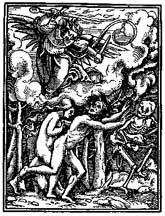 But you know the story... along comes that crafty old serpent to mess everything up. He tempts the humans by saying that what they were wasn't enough... they could be more. They should strive to know more and to be more. Though they had no sin or shame, he tempted them with pride, and they bought it.
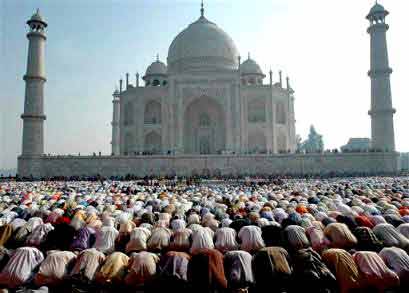 Shame moves us to religion. All the world religions continue to insist that if we work hard to do good, and if we just live like the good people we really are, whatever creator-being there is will be good to us as well. That's pride... it's not an honest evaluation of what's in my heart. But that's the wisdom of this world; the 'wisdom' God saw, when he said 'I will destroy the wisdom of the wise, and the discernment of the discerning I will thwart.'
Well, I'm back from a bit of a 'whirlwind' vacation that wasn't really at all like what we planned. Oh well. Here are a few of the highlights. Obviously, highlight number one was just being able to get away with my wife (although our 'alone time' was more limited than we had originally hoped). I would post a picture of the two of us, but I somehow think she would disapprove, so here are some other highlights. Me and three friends from church (including Jason and Jim) went on a gruelling, 11 hour canoe trip across the whole of northern Ontario (or so it seemed to my shoulders, anyway...) that just about killed us. But it was good times together, good weather, and a beautiful display of God's creation.
But I learned that you're not supposed to drink the water, even if you're very, very thirsty. There's something called 'Beaver Fever' around that I had never heard of before... Since Josh got to brag about his niece, I figured I have every right to do the same with my nephew, Wes (my brother Ryan's son). I still think this cute little man resembles his uncle at that age, no matter what everyone else says. :) Here he is enjoying a watermelon for everything it's worth.
And, of course, God was very gracious to us by blessing us with a gorgeous display in the skies our final night before our return to 'the big smoke' we call home. They're never the same in pictures, but the skies truly do proclaim the glory of God.
 Ever wonder why asceticism figures so prominently in church history? It started very early on. Many of the figures we are much indebted to (Augustine, Jerome, Basil the Great, Benedict, Patrick, etc.) throughout church history have had some strong leanings toward monasticism.
Now that the 'clean sea breeze of the centuries' has blown our minds clear from excessive faults, we often look back and wonder with amazement: 'How could such great Christians have been so blind as to become ascetics?' We don't understand what brought them to this.
A bit of background, then, is in order. Christianity was persecuted on and off and to varying degrees for the first few centuries after Christ. It is absolutely miraculous, and a wonderful testimony to the power of the Spirit and the grace of God, that the church continued to grow by leaps and bounds throughout the Empire, even under such hardships. After a while, however, the persecution stopped. When Emperor Constantine was converted (around AD 312) the seeds of 'cultural Christianity' were beginning to grow roots. It would still be some years, however, before Christianity became the 'state religion.'
Up to that point, to identify yourself as a Christian cost you something. You had to be willing to suffer and to lose things you had worked for. Once Christianity became cultural, there were no more martyrs, no more persecution. Now it cost nothing to be a Christian. Anyone could do it. The churches were soon all filled to the brim as people began to realize there was much socially and politically to gain from being a 'Christian.'
Where once Christianity had been identified with righteousness of life and high moral standards, the now popular religion began to see moral decay from within. The high standards were lowered to the point that one could hardly tell the difference between 'Christians' and unbelievers. Of course, the true believers were put off by this! Moral compromise should never be tolerated in the church, under any circumstances, and they recognized this. They knew that to be a Christian should cost them something, that they should stand out and be different than the decadent culture around them.
So... Christianity is popular and acceptable. It costs nothing to be a Christian. The churches are full of 'cultural Christians.' The Christians don't look a lot different than the decadent society in which they live. (Am I describing their culture or ours?)
Their answer, of course, was that the truest, highest form of Christianity is that which costs the most. So they left everything behind: all their possesions, their family and friends, the luxuries of urban living, the right to marry, and the wealth of food, etc.
The New Testament seems relatively clear that we are not called to an ascetic lifestyle. But rather than condemning these brothers and sisters for fleeing to monasteries, we should seek to understand why they did what they did. And understanding that, we need to emulate their desire to stand out! They were not content with Christians who look just like unbelievers--and we shouldn't be either!
So we can err by becoming ascetic and we can err by not seeking to be different at all. But we can also err in another way: We can seek to become 'righteous' in the way that our philosophical climate deems good. Why did they resort to asceticism when they thought they should be different? Because that's what the greatest thinkers of their time valued as great righteousness.
When we seek to be different from the culture around us, we need to be careful that we're not merely emulating the philosophical, ethical ideals of our day. Paul said, 'Do not be conformed to the pattern of this age,' and I think he meant it. Which of course means that we need to think hard. How do I live as a Christian in a way that is different from nominal Christianity, but not simply according to the patterns that the world has established as right and good and self-sacrificing?
All this, of course, means that we need to continue to let that 'clean sea breeze' blow... we need to read church history so that we're not merely influenced by the ideologies of our day. But more than anything, it means we need to be people of the book. We need to read the Word of God and know it intimately so that we'll be able to discern all that is pleasing and right in the eyes of the God who wrote the book.
That is, after all, why we're here.
See parts 1, 2, and 3.
We lose poverty of spirit because we lose sight of God. Once we lose sight of God it is easy to lose sight of how far short of his standard we really fall--we forget what we were when we were called. But someone might say, 'but I was never an adulterer or a thief; I never killed and rarely lied. I know that I fell short, but not nearly so bad as most others.'
As far as I can tell, this one has missed the point in no less than three ways. The first is the simple truth that all are compared to God, since he is the ultimate standard. If you are truly comparing yourself against the real standard, what does it matter if you're not bad as another man? You still fall short!
The second is that it assumes that you were already as bad as you were going to get. Sometimes we forget the pattern of sin is not a straight line. The crackhead doesn't start out on crack. The sex-offender doesn't start out by raping. Sin always progresses, it is never satisfied, it always wants more.
John Owen used the image of a muddy field. The first time you start walking on the field you won't get very far... your boots get stuck. But the next time you walk out, that mud is already trampled down, so it's easier to get at least as far--you get to the same spot quicker. But since it was easier for you to get there, you can keep going. Each time you walk out into the field you automatically start from the spot where you left off. The first time the crackhead smoked pot it was a big deal. Now he can't get through a day without it.
Paul described false teachers in the church this way too. They never start out as bad as they end up and they're never as bad as they will get. They continue on, going from bad to worse, deceiving and being deceived.
So... in the midst of all this, what would ever make me think that I was as bad when God saved me as I would ever get? What is there to make me think that I wouldn't keep getting worse? All the evidence seems to suggest that I would continue on in my sin, diving further and further into fleshly desires.
So let no one say, 'I never did this or that,' because you very well may have if God had not saved you when he had. Which leads to the third way in which these ones miss the point when we say that all have fallen short and none has reason to be proud over another.
The third way that this statement misses the point is that it assumes that it was your goodness which held you back from being as sinful as any other man. The only reason that one could
possibly have to be proud and say that he is not as bad as the next is if he had some good in him which another did not which enabled him to resist sin.
But Scripture does not put things in these terms. The process of becoming more and more depraved is described in Romans 1. There we are told that man continually suppresses the truth of the righteousness of God in his unrighteousness. He longs for sin in increasing measure. God's wrath on man on this world is revealed through his giving men over into more and more sin. See the picture? Who do the Scriptures place as sovereign over the sins of man? Not man, but God.
Again, there are similary frightening verses in Romans 9 (here in particular). Here we are told that God, in his sovereignty, is the determining factor in man's acceptance or rejection of him. So God is sovereign over the sins of the unregenerate, and sovereign over the salvation of all. Where then is our reason for boasting?
Paul draws the same conclusions in Romans 12. Here he says that there must not be a single Christian in the church who thinks more highly of himself than he ought. Well, how highly ought he to think of himself? Only according to the faith he has received.
Did you catch that?
The faith he has received.
Our only reason for boasting is our faith in Christ, and that was a gift that was given to him by God, not something that he did for himself or earned for himself. Outisde of Christ we have nothing to boast of, and once in Christ we have only Christ to boast of. Let us then seek to be more and more humble, counting others as better than ourselves.
See parts 1 and 2.
So what causes Christians to lose their 'poverty of spirit'? Losing sight of the God we say we worship is the main cause. But part and parcel with that comes losing sight of who we are and what we are really like. When we forget God, who is the ultimate standard of all things, what can we measure ourselves by? We proudly and arbitrarily draw flattering standards against which we can measure up well.
One way in which we fail to measure ourselves accurately is by forgetting what we were. Sometimes, the longer we live as Christians, we forget the way we were before we were saved. Paul plainly states in 1 Corinthians that the church there was made up of ex adulterers, idolaters, homosexuals, thieves, revilers, swindlers, etc. I somehow doubt that any church drawn from our society today would look a whole lot different.
The fact is that the Christians who make up a church are Christians who sinned in every way that those in the world around us sin. The only difference is what God has done in us. That's what Paul says: 'But you were washed, you were sanctified, you were justified in the name of the Lord Jesus Christ and by the Spirit of our God.' Catch that? It was all done to us, not stuff that we've done to make ourselves better than anyone.
It's easy to forget that... but we must never forget that! We must never forget that we were all these things when we were 'purchased at a price.' We must never forget that it was while we were still sinners that Christ died for us.
In fact, earlier on in the same letter to the Corinthians, Paul told them to make sure they remembered what they were before they were Christians. He basically says in chapter 1 that they should remember that not many of them were the wise, noble, rich, influential, etc. God chose them because they were the foolish, the weak, the poor, the shameful. He chose these ones so that his power could be shown as even his foolishness shames the wisdom of this world.
We need to remember what we were before we were saved: what my passions and desires were, how I loved my sin, how I pursued my sin and hated God with my actions. When we remember that we were idolaters and adulterers and greedy thieving swindlers hording worldly possessions it becomes that much harder to exalt ourselves over others who are guilty of the same sins, whether or not they've repented of them.


You are my God, my Life, my Holy Delight. But is this enough to say of you? Can any man say enough when he speaks of you? Yet woe betide him who remains silent about you!
