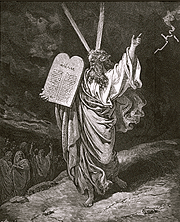
Friday, July 07, 2006

Thoughts on Poverty of Spirit - 4

See parts 1, 2, and 3.

We lose poverty of spirit because we lose sight of God. Once we lose sight of God it is easy to lose sight of how far short of his standard we really fall--we forget what we were when we were called. But someone might say, 'but I was never an adulterer or a thief; I never killed and rarely lied. I know that I fell short, but not nearly so bad as most others.'

As far as I can tell, this one has missed the point in no less than three ways. The first is the simple truth that all are compared to God, since he is the ultimate standard. If you are truly comparing yourself against the real standard, what does it matter if you're not bad as another man? You still fall short!

The second is that it assumes that you were already as bad as you were going to get. Sometimes we forget the pattern of sin is not a straight line. The crackhead doesn't start out on crack. The sex-offender doesn't start out by raping. Sin always progresses, it is never satisfied, it always wants more.

John Owen used the image of a muddy field. The first time you start walking on the field you won't get very far... your boots get stuck. But the next time you walk out, that mud is already trampled down, so it's easier to get at least as far--you get to the same spot quicker. But since it was easier for you to get there, you can keep going. Each time you walk out into the field you automatically start from the spot where you left off. The first time the crackhead smoked pot it was a big deal. Now he can't get through a day without it.

Paul described false teachers in the church this way too. They never start out as bad as they end up and they're never as bad as they will get. They continue on, going from bad to worse, deceiving and being deceived.

So... in the midst of all this, what would ever make me think that I was as bad when God saved me as I would ever get? What is there to make me think that I wouldn't keep getting worse? All the evidence seems to suggest that I would continue on in my sin, diving further and further into fleshly desires.

So let no one say, 'I never did this or that,' because you very well may have if God had not saved you when he had. Which leads to the third way in which these ones miss the point when we say that all have fallen short and none has reason to be proud over another.

The third way that this statement misses the point is that it assumes that it was your goodness which held you back from being as sinful as any other man. The only reason that one could
possibly have to be proud and say that he is not as bad as the next is if he had some good in him which another did not which enabled him to resist sin.

But Scripture does not put things in these terms. The process of becoming more and more depraved is described in Romans 1. There we are told that man continually suppresses the truth of the righteousness of God in his unrighteousness. He longs for sin in increasing measure. God's wrath on man on this world is revealed through his giving men over into more and more sin. See the picture? Who do the Scriptures place as sovereign over the sins of man? Not man, but God.

Again, there are similary frightening verses in Romans 9 (here in particular). Here we are told that God, in his sovereignty, is the determining factor in man's acceptance or rejection of him. So God is sovereign over the sins of the unregenerate, and sovereign over the salvation of all. Where then is our reason for boasting?

Paul draws the same conclusions in Romans 12. Here he says that there must not be a single Christian in the church who thinks more highly of himself than he ought. Well, how highly ought he to think of himself? Only according to the faith he has received.

Did you catch that?

The faith he has received.

Our only reason for boasting is our faith in Christ, and that was a gift that was given to him by God, not something that he did for himself or earned for himself. Outisde of Christ we have nothing to boast of, and once in Christ we have only Christ to boast of. Let us then seek to be more and more humble, counting others as better than ourselves.

Thursday, July 06, 2006

Thoughts on Poverty of Spirit - 3

See parts 1 and 2.

So what causes Christians to lose their 'poverty of spirit'? Losing sight of the God we say we worship is the main cause. But part and parcel with that comes losing sight of who we are and what we are really like. When we forget God, who is the ultimate standard of all things, what can we measure ourselves by? We proudly and arbitrarily draw flattering standards against which we can measure up well.

One way in which we fail to measure ourselves accurately is by forgetting what we were. Sometimes, the longer we live as Christians, we forget the way we were before we were saved. Paul plainly states in 1 Corinthians that the church there was made up of ex adulterers, idolaters, homosexuals, thieves, revilers, swindlers, etc. I somehow doubt that any church drawn from our society today would look a whole lot different.

The fact is that the Christians who make up a church are Christians who sinned in every way that those in the world around us sin. The only difference is what God has done in us. That's what Paul says: 'But you were washed, you were sanctified, you were justified in the name of the Lord Jesus Christ and by the Spirit of our God.' Catch that? It was all done to us, not stuff that we've done to make ourselves better than anyone.

It's easy to forget that... but we must never forget that! We must never forget that we were all these things when we were 'purchased at a price.' We must never forget that it was while we were still sinners that Christ died for us.

In fact, earlier on in the same letter to the Corinthians, Paul told them to make sure they remembered what they were before they were Christians. He basically says in chapter 1 that they should remember that not many of them were the wise, noble, rich, influential, etc. God chose them because they were the foolish, the weak, the poor, the shameful. He chose these ones so that his power could be shown as even his foolishness shames the wisdom of this world.

We need to remember what we were before we were saved: what my passions and desires were, how I loved my sin, how I pursued my sin and hated God with my actions. When we remember that we were idolaters and adulterers and greedy thieving swindlers hording worldly possessions it becomes that much harder to exalt ourselves over others who are guilty of the same sins, whether or not they've repented of them.

Thursday, June 29, 2006

Thoughts on Poverty of Spirit - 2

So how could it be that Christians would become proud? Having started with nothing, how could receiving freely give us reason to boast? It seems that pride is the sneakiest of all sins, working from the core of the heart, seeking any opportunity to morph and reappear undetected.

I think the first step in losing poverty of spirit is losing sight of who God is and what he demands.

The two most famous theophanies seem to be Moses on Sinai and Isaiah's vision in the year that Uzziah died. With everything in me, try as I might, I can't imagine a way that a person could remain proud in those circumstances. Even Moses, with whom God would speak(!) could not see him or else he would die.

In Isaiah's vision even the creatures around Jesus' throne could not look upon him, but were forced to cover both their faces and their feet. When Christians fail to recognize that it is a terrifying thing to fall into the hands of the living God who is a consuming fire, we cease to lose touch with the God of the Bible. When we forget that we ought rightly to be afraid of him, we are venturing toward pride.

But not only do we need to remember who God is, but we also need to remember what he demands of us. Throughout the Old Testament God thundered down the Law and declared through the prophets, 'Be holy, as I am holy! It startles me to think that we as Christians can be so easy on our sin when we read this. Do we not realize what it says? And it is not merely an 'Old Testament' thing, either! Jesus declares that we must 'Be perfect as your heavenly Father is perfect.'

In other words, the standard is God. Now, if you haven't rightly evaluated who God is, that's not that big of a deal. But if you have truly seen the God of the Bible for who he is, and then have realized that he himself is the standard, then you realize quite quickly why exactly Isaiah cried out 'woe is me!' and why Paul could so brazenly say 'all have fallen short of the glory of God' because all have broken the law. The law is not the standard... the law bears witness to the standard, but the standard is God himself!

I may think that I measure up okay in my Christian life... I don't sin openly. I've read more books than other Christians (and better books too!). I go to church all the time, I teach Sunday school, all my friends are Christians... But in reality, how I measure up against other Christians is never, ever used as a realistic standard by which we ought to measure ourselves.

If we evaluate ourselves against others around us we might think we're doing alright. In reality, however, we ought to be measuring ourselves against God, because he is what he demands from us, and nothing less.

Honestly comparing ourselves to the God of the Bible should produce poverty of Spirit where nothing else will. Once again, our greatest need is to turn to the word of God, to behold God, to know him for who he is. Only that will make us who and what we need to be.

Tuesday, June 27, 2006

Some Thoughts on Poverty of Spirit

"Blessed are the poor in spirit, for theirs is the kingdom of heaven."

With these words our Lord's ministry began in earnest. The long-awaited promised one brings the fulfilment of all that was foreshadowed in the Law and the Prophets in his person and his kingdom, and these are those to whom his kingdom belongs: those who are poor in spirit.

In the plainest sense poverty of spirit is simply the heart of contrition and repentance that God has always required from his people (a few examples). God has always declared that he would dwell with the humble and cast out the presumptuous and haughty, those who think that they have no need of God: Christ did not even come for those who don't need a physician.

So first and foremost, to have any part in the kingdom (saving reign) of God (in Christ) we must recognize that he is holy, and that we are sinners without a plea before him. We deserve nothing from him, plain and simple, but come to him fully knowing that it would be good and right of him to damn me to hell. He would be just and good and righteous and glorified to send me to the place where there is weeping and gnashing of teeth, to the Gehenna of fire, where the worm is never satisfied.

But this is nothing new, of course. If you're a Christian, you've already been here and known this to be true in your own heart. So why doesn't it last? How could it be that having come through the front door of utter humility and contrition we now think it appropriate to dwell in the room of luxurious pride and haughtiness of thought? What would possibly cause a Christian to ever think of himself as better than anyone else?

It seems that the nature of the gospel which Christ brings is such that pride in a Christian should be an impossibility. It begins with humility, continues in self-sacrificing love, and concludes with eternal praise--it is never about self; not for a moment.

Over the next couple of posts I hope to put forward a few thoughts about poverty of spirit: Why Christians lose it and how to further affect it.

Monday, June 26, 2006

"Please show me your glory!"

Every child knows the story from Sunday School. From the time we're little we picture it... Moses goes up the mountain to speak with God. God is there, in a cloud, fire, and lightning and the people are afraid. But God speaks with Moses. Amazing!

But then the unthinkable happens: Moses dares to ask for even more! Now he wants to see God!

We tremble to think of how daring this is--but what if...

So God causes his glory to pass by Moses. You can read about it here. But here's the thing that I wonder. I know the way I pictured this when I was little. I know how I think God must've looked to Moses as he passed by. And then I think, "If only I could see God like that, it would totally change the way I live! I would never struggle with sin again!"

But maybe I need to reevaluate the way I think about this.

How about this: Have I thought that I have beheld more of God than Moses? I'm sure Moses saw Jesus, but did he see calvary? Did he see God dwelling with man in the New Jerusalem? He did not see the fullness of the revelation that we have in the completed Old and New Testaments. (If you think this isn't a valid comparison, check this out.)

What have I seen of God? If I haven't seen him, it's probably because my eyes aren't open. What Moses saw part of, while hidden in a rock on a mountain, we leave on our bookshelf gathering dust.

And then we wonder why we struggle with indwelling sin...

If we want our faces to shine, we must behold more of God--we must find him in his Word.

Tuesday, June 20, 2006

The Abandonment of Christian Atonement

Christians never cease to amaze me. In our contemporary 'conversation' we find people rejecting the idea of penal substitution, the imputation of righteousness, justification by grace alone, through faith alone, etc., etc., etc.

The thing that really bothers me about this is the arrogance with which such historic Christian doctrines are tossed aside in such a cavalier manner. We are told that these ideas of God being 'angry' and desiring to make his Son pay the 'punishment' as a 'substitute' to give us a 'forensic', 'legal' righteous standing before God are western, modern, and un-nuanced. We are told that for hundreds of years we've been reading the New Testament through the eyes of Luther, rather than first-century Judaism.

Bogus.

Below is an excerpt from the Epistle to Diognetus, written in the second-century AD, one of the earliest extant apologies for the Christian faith outside of the New Testament. In this section the author discusses the nature of the atonement, as taught in the New Testament. What this is an attempt to show is that the abandonement of penal substitutionary atonement which accomplishes justification (including the imputation of righteousness) by grace alone through faith alone is not just an abandonment of modern, western Christianity, but is an abandonment of historic, biblical Christianity at its very core.

_____________________________________________________

But when our iniquity was fulfilled and it had been made fully manifest that its reward of punishment and death was awaited, and the season came which God had appointed to manifest henceforth His own goodness and power (O the exceeding kindness and love of God!), He did not hate us or repel us or remember our misdeeds, but was long-suffering, bore with us, Himself in mercy took on Him our sins, Himself gave up His own Son as a ransom for us, the holy One for the wicked, the innocent for the guilty, “the just for the unjust”, the incorruptible for the corruptible, the immortal for mortals. For what else could cover our sins but his righteousness? In whom was it possible for us, wicked and impious as we were, to be justified, except in the Son of God alone? O the sweet exchange, O work of God beyond all searching out, O blessings past our expectation, that the wickedness of many should be hidden in one righteous Man and the righteousness of the One should justify many wicked!


-- Taken from The Epistle to Diognetus, IX.2-5. The is one of the earliest extant apologies for the Christian faith, written in the second century ad, within decades of the death of the apostle John.

Monday, June 12, 2006

The Myth of Homophobia

I don't believe in homophobia.

I know there are people who don't like homosexuals. I know there are people who are incredibly uncomfortable with the thought of being "hit on" by a gay person. I know there are people with all kinds of bizarre ideas about what "causes" one person to be homosexual while the majority of people remain straight. But I don't believe in what is commonly referred to as homophobia.

People throw this word around as a term of derision at anyone who expresses discomfort or displeasure or disapproval with the prevalence, common acceptance, and forceful agenda-pushing of homosexuality. It somehow seems ironic for "them" to give such a derogatory label to those who disagree with them. Isn't it they who desire for openness?

The common use of this word "homophobia" is propaganda, plain and simple. If you disagree with the proposition that homosexuality is a "legitimate alternative lifestyle" then you are a homophobe. No one wants to be a homophobe. So if it's a choice between the two, people will just simply choose to accept homosexuality--not because they feel comfortable with it, but because they don't want to be labelled "bigot", "homophobe", "religious fundamentalist", etc.

Like any sin, homosexuality is built off of and continues to feed off of pride. If I can make everyone else accept my sin then maybe I'll feel better about myself and my conscience will quit bothering me.

The truth of the matter, however, is that homosexuality is sin. It flies in the face of all that God created humanity to be. It pushes men to not be men and women to not be women--but God created us to be those so that we could bear his image! Being gay destroys the image of marriage as a picture of Christ and his bride (if you read Eph 5 carefully you'll see that the marriage of Adam and Eve was designed in order to represent the relationship that God would one day have with his people... it's not like God saw marriage and then one day thought, "hey that's kinda like a metaphor for me and them!").

It is natural that what remains in us of the image of God would be repulsed by what is so blatanly ungodlike. This is especially true for Christians, because we have seen the wonder and the beauty and the infinite wisdom of God in his creation. We have seen from his word the kind of people--men and women distinct, yet equally wonderful--he wants us to be. We have seen that there are reasons for all that God requires of us, and that all these things are beautiful.

In this culture, in this day, in this city everyone says it is wrong to be repulsed by homosexuality. "Don't speak about it loudly... someone might hear." It has gotten to the point now where I've caught myself (a) not being repulsed by blatantly gay things around me, and (b) feeling bad when I am repulsed by it.

THIS MUST STOP!

I'm not homophobic, but it grosses me out and I think it should! It is an abomination before the Lord, a perversion of the created order, and blatant, proud, boastful, haugty, flagrant sexual immorality in the heart of men and women who care nothing for God or the wonder and splendour of his righteousness and who presume on his patience and forebearance.

To speak of this sin as what it actually is is not homophobia and I will not be ashamed to declare that homosexuality is wrong. I don't hate anyone for their sin, but I will no longer shrink back from calling a spade what it rightly is... no matter what.

T-Minus Two Days

Pro-choicers, Protestors, and Praised Evangelist

My friend David Rainer over at "A Far Green Country" has an insightful lament over the Southern Baptist Convention. It was an eye-opener for me. Definitely worth checking out.

A Far Green Country: Pro-Choicer, Protestors, & Praised Evangelist

Injury Wars (Concluded)

So it turns out that even first thing on a Monday morning, there is still the sound of great winds coming from the jetport. It never ends.

But because he was so kind as to post this picture (a bruise... hmmm... has anyone else ever had a bruise?), I thought I would post an update as well. (Ken and David asked for me to post updates too, so in deference to them...)

Check this out:
As if anyone could suggest that a little bruise is worse than POISON IVY BETWEEN YOUR TOES!!

Friday, June 09, 2006

Comparing Ankles

So kerux thinks he's got it rough, eh?

Poor baby. Come on... honestly. Which one looks worse to you?


This little ankle sore?


Or this nasty POISON IVY?!!?
BTW, it is getting better even though I did not solicit sympathy for my pain via my blog.


__________________________________________


Just for comparison's sake, here's my poison ivy from a few years back, just as it was breaking out.

Thursday, June 01, 2006

Context: The Ultimate Trump Card

I was talking with my good friend Jim the other day after church and he said something quite humorous and very insightful. Since he didn't post it, I thought I would steal that thought from him and use it on my blog.

In our conversation we were discussing a bizarre post I read on another blog. Even more bizarre than the post itself was an open theist who responded to it. I replied (I think graciously :-) ) to this comment with many biblical texts which fly in the face of a 'god' who doesn't know the future.

In particular I challenged him to examine Is 45-48 where God (YHWH) is presented as the true, real, and living God over-against all false gods because he can declare what will come to pass (he has declared it from the beginning!). The argument, then, is that in order to be truly God, he must know the future!

Our friendly open theist's response: 'You've taken all those verses out of context!'

Blast! That darned context trump card! He got me... well, I guess there goes the argument for classical theism.

Jim's insight: People don't even know what 'out of context' means anymore. They've just heard it bantered around so much that they figure it can disprove (trump) any statement of the Bible that leads to a conclusion different than the one they want to draw.

Unbelievable. Get a hermeneutic, would you?!

Tuesday, May 30, 2006

The Catchphrase That Can't...

Much has been made in other places about the cheesy PoMo quasi-evangelical catchphrases such as 'dialogue', 'story', 'journey', 'romance', etc. I would like to comment here on the term 'conversation.'

A 'conversation' is apparently when more than one PoMo gathers, and they begin to speak. They pile up one non-descript cliché (see above for some popular choices) on top of another, each describing their own 'authentic experience' (their story) which becomes, to each of them, uniquely authoritative for their own journey.

Perhaps the reason why these ones are so quick to devalue language and its inherent meaning is because they simply have chosen to create a dialect of their own, in which each one of the seven (7) words they know becomes entirely defined by its own context (the word's story??). Interpretation, then (and thus, meaning, as well), is entirely in the ear of the hearer.

No wonder they can connect and have such wonderfully meaningful 'conversations'... Everyone tells me my own interpretation of their story... which I interpret the way I do because of my own story... how wonderful!

All that, however, is simply by way of introduction. The reason I wanted to write about the term 'conversation' is because I feel it has been violated, perhaps worse than the others.

It is often stated that the truly 'missional' Christian will not seek to win 'converts', but rather to make 'relationships' which will lead to truly 'meaningful' and 'mutually beneficial' conversations. Only mean old moderns want converts. Hip missional Christians know that conversations are much better.

But that is a lie. This catchphrase simply doesn't work the way they want it to work (which is quite sad, really, because it does sound very pious of them).

The trouble is that conversation is not the goal of a Christian. Conversion of sinners is. While I understand that many emergent types are reacting against the old 'crusade' style of evangelism, they are throwing not just the baby, but also the mother, out with the bathwater.

To be a Christian means that I love God. It is to God's glory to see sinners saved. That's why he sent his Son... that's why we're called to go to every nation and make disciples. We're not told to go to the ends of the world to stake our share in the marketplace of ideas.

To be a Christian means that I love others. I love because God first loved me. Being saved, I know that it is to the benefit of any man, woman, boy, or girl to be saved. To know Jesus is the most eminently wonderful joy the soul could ever know. Why would I want to deny to someone that I really want them to know the greatest, truest, only absolutely sovereign joy the world will ever know? So that we could 'have conversation'?

What a joke.

Either you desire sinners to be saved, or you're not a Christian because you obviously haven't understood that it's to the glory of God and for the good of the person for them to be saved!

So one of two things is happening here. Either these wonderfully conversational emergent types are really seeking conversions through conversations (which seems awfully deceptive... why not just say what you mean? Tell them what you really want!) or else they really think that the world has as much to offer them as they have to offer the world.

If the latter is their mindset than I would argue it is true. The world does have as much to offer as they do... which is absolutely zero. Only a heart that has never experienced the true grace and love of God in the forgiveness of Christ and the comfort of the Holy Spirit could ever think that the world has anything to offer them.

Monday, May 29, 2006

He nailed it!

Al Mohler, once again, provides an analysis of culture and its religion which proves to be insightful and useful. He has hit the nail on the head. Christianity's greatest enemy and rival is 'liberal Christianity.'

Al Mohler's Two Rival Religions is definitely worth the read.

Wednesday, May 24, 2006

The Way it's Supposed to Be...

My wife pointed me to this post on the GirlTalk blog today... I don't get it... it isn't supposed to be this way...?

On men and bbq-ing