Monday, June 26, 2006

"Please show me your glory!"
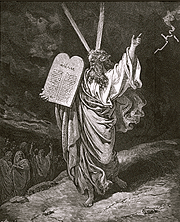
Every child knows the story from Sunday School. From the time we're little we picture it... Moses goes up the mountain to speak with God. God is there, in a cloud, fire, and lightning and the people are afraid. But God speaks with Moses. Amazing!

But then the unthinkable happens: Moses dares to ask for even more! Now he wants to see God!

We tremble to think of how daring this is--but what if...

So God causes his glory to pass by Moses. You can read about it here. But here's the thing that I wonder. I know the way I pictured this when I was little. I know how I think God must've looked to Moses as he passed by. And then I think, "If only I could see God like that, it would totally change the way I live! I would never struggle with sin again!"

But maybe I need to reevaluate the way I think about this.

How about this: Have I thought that I have beheld more of God than Moses? I'm sure Moses saw Jesus, but did he see calvary? Did he see God dwelling with man in the New Jerusalem? He did not see the fullness of the revelation that we have in the completed Old and New Testaments. (If you think this isn't a valid comparison, check this out.)

What have I seen of God? If I haven't seen him, it's probably because my eyes aren't open. What Moses saw part of, while hidden in a rock on a mountain, we leave on our bookshelf gathering dust.

And then we wonder why we struggle with indwelling sin...

If we want our faces to shine, we must behold more of God--we must find him in his Word.

Tuesday, June 20, 2006

The Abandonment of Christian Atonement

Christians never cease to amaze me. In our contemporary 'conversation' we find people rejecting the idea of penal substitution, the imputation of righteousness, justification by grace alone, through faith alone, etc., etc., etc.

The thing that really bothers me about this is the arrogance with which such historic Christian doctrines are tossed aside in such a cavalier manner. We are told that these ideas of God being 'angry' and desiring to make his Son pay the 'punishment' as a 'substitute' to give us a 'forensic', 'legal' righteous standing before God are western, modern, and un-nuanced. We are told that for hundreds of years we've been reading the New Testament through the eyes of Luther, rather than first-century Judaism.

Bogus.

Below is an excerpt from the Epistle to Diognetus, written in the second-century AD, one of the earliest extant apologies for the Christian faith outside of the New Testament. In this section the author discusses the nature of the atonement, as taught in the New Testament. What this is an attempt to show is that the abandonement of penal substitutionary atonement which accomplishes justification (including the imputation of righteousness) by grace alone through faith alone is not just an abandonment of modern, western Christianity, but is an abandonment of historic, biblical Christianity at its very core.

_____________________________________________________

But when our iniquity was fulfilled and it had been made fully manifest that its reward of punishment and death was awaited, and the season came which God had appointed to manifest henceforth His own goodness and power (O the exceeding kindness and love of God!), He did not hate us or repel us or remember our misdeeds, but was long-suffering, bore with us, Himself in mercy took on Him our sins, Himself gave up His own Son as a ransom for us, the holy One for the wicked, the innocent for the guilty, “the just for the unjust”, the incorruptible for the corruptible, the immortal for mortals. For what else could cover our sins but his righteousness? In whom was it possible for us, wicked and impious as we were, to be justified, except in the Son of God alone? O the sweet exchange, O work of God beyond all searching out, O blessings past our expectation, that the wickedness of many should be hidden in one righteous Man and the righteousness of the One should justify many wicked!


-- Taken from The Epistle to Diognetus, IX.2-5. The is one of the earliest extant apologies for the Christian faith, written in the second century ad, within decades of the death of the apostle John.

Monday, June 12, 2006

The Myth of Homophobia

I don't believe in homophobia.

I know there are people who don't like homosexuals. I know there are people who are incredibly uncomfortable with the thought of being "hit on" by a gay person. I know there are people with all kinds of bizarre ideas about what "causes" one person to be homosexual while the majority of people remain straight. But I don't believe in what is commonly referred to as homophobia.

People throw this word around as a term of derision at anyone who expresses discomfort or displeasure or disapproval with the prevalence, common acceptance, and forceful agenda-pushing of homosexuality. It somehow seems ironic for "them" to give such a derogatory label to those who disagree with them. Isn't it they who desire for openness?

The common use of this word "homophobia" is propaganda, plain and simple. If you disagree with the proposition that homosexuality is a "legitimate alternative lifestyle" then you are a homophobe. No one wants to be a homophobe. So if it's a choice between the two, people will just simply choose to accept homosexuality--not because they feel comfortable with it, but because they don't want to be labelled "bigot", "homophobe", "religious fundamentalist", etc.

Like any sin, homosexuality is built off of and continues to feed off of pride. If I can make everyone else accept my sin then maybe I'll feel better about myself and my conscience will quit bothering me.

The truth of the matter, however, is that homosexuality is sin. It flies in the face of all that God created humanity to be. It pushes men to not be men and women to not be women--but God created us to be those so that we could bear his image! Being gay destroys the image of marriage as a picture of Christ and his bride (if you read Eph 5 carefully you'll see that the marriage of Adam and Eve was designed in order to represent the relationship that God would one day have with his people... it's not like God saw marriage and then one day thought, "hey that's kinda like a metaphor for me and them!").

It is natural that what remains in us of the image of God would be repulsed by what is so blatanly ungodlike. This is especially true for Christians, because we have seen the wonder and the beauty and the infinite wisdom of God in his creation. We have seen from his word the kind of people--men and women distinct, yet equally wonderful--he wants us to be. We have seen that there are reasons for all that God requires of us, and that all these things are beautiful.

In this culture, in this day, in this city everyone says it is wrong to be repulsed by homosexuality. "Don't speak about it loudly... someone might hear." It has gotten to the point now where I've caught myself (a) not being repulsed by blatantly gay things around me, and (b) feeling bad when I am repulsed by it.

THIS MUST STOP!

I'm not homophobic, but it grosses me out and I think it should! It is an abomination before the Lord, a perversion of the created order, and blatant, proud, boastful, haugty, flagrant sexual immorality in the heart of men and women who care nothing for God or the wonder and splendour of his righteousness and who presume on his patience and forebearance.

To speak of this sin as what it actually is is not homophobia and I will not be ashamed to declare that homosexuality is wrong. I don't hate anyone for their sin, but I will no longer shrink back from calling a spade what it rightly is... no matter what.

T-Minus Two Days

Pro-choicers, Protestors, and Praised Evangelist

My friend David Rainer over at "A Far Green Country" has an insightful lament over the Southern Baptist Convention. It was an eye-opener for me. Definitely worth checking out.

A Far Green Country: Pro-Choicer, Protestors, & Praised Evangelist

Injury Wars (Concluded)

So it turns out that even first thing on a Monday morning, there is still the sound of great winds coming from the jetport. It never ends.

But because he was so kind as to post this picture (a bruise... hmmm... has anyone else ever had a bruise?), I thought I would post an update as well. (Ken and David asked for me to post updates too, so in deference to them...)

Check this out:
As if anyone could suggest that a little bruise is worse than POISON IVY BETWEEN YOUR TOES!!

Friday, June 09, 2006

Comparing Ankles

So kerux thinks he's got it rough, eh?

Poor baby. Come on... honestly. Which one looks worse to you?


This little ankle sore?


Or this nasty POISON IVY?!!?
BTW, it is getting better even though I did not solicit sympathy for my pain via my blog.


__________________________________________


Just for comparison's sake, here's my poison ivy from a few years back, just as it was breaking out.

Thursday, June 01, 2006

Context: The Ultimate Trump Card

I was talking with my good friend Jim the other day after church and he said something quite humorous and very insightful. Since he didn't post it, I thought I would steal that thought from him and use it on my blog.

In our conversation we were discussing a bizarre post I read on another blog. Even more bizarre than the post itself was an open theist who responded to it. I replied (I think graciously :-) ) to this comment with many biblical texts which fly in the face of a 'god' who doesn't know the future.

In particular I challenged him to examine Is 45-48 where God (YHWH) is presented as the true, real, and living God over-against all false gods because he can declare what will come to pass (he has declared it from the beginning!). The argument, then, is that in order to be truly God, he must know the future!

Our friendly open theist's response: 'You've taken all those verses out of context!'

Blast! That darned context trump card! He got me... well, I guess there goes the argument for classical theism.

Jim's insight: People don't even know what 'out of context' means anymore. They've just heard it bantered around so much that they figure it can disprove (trump) any statement of the Bible that leads to a conclusion different than the one they want to draw.

Unbelievable. Get a hermeneutic, would you?!

Tuesday, May 30, 2006

The Catchphrase That Can't...

Much has been made in other places about the cheesy PoMo quasi-evangelical catchphrases such as 'dialogue', 'story', 'journey', 'romance', etc. I would like to comment here on the term 'conversation.'

A 'conversation' is apparently when more than one PoMo gathers, and they begin to speak. They pile up one non-descript cliché (see above for some popular choices) on top of another, each describing their own 'authentic experience' (their story) which becomes, to each of them, uniquely authoritative for their own journey.

Perhaps the reason why these ones are so quick to devalue language and its inherent meaning is because they simply have chosen to create a dialect of their own, in which each one of the seven (7) words they know becomes entirely defined by its own context (the word's story??). Interpretation, then (and thus, meaning, as well), is entirely in the ear of the hearer.

No wonder they can connect and have such wonderfully meaningful 'conversations'... Everyone tells me my own interpretation of their story... which I interpret the way I do because of my own story... how wonderful!

All that, however, is simply by way of introduction. The reason I wanted to write about the term 'conversation' is because I feel it has been violated, perhaps worse than the others.

It is often stated that the truly 'missional' Christian will not seek to win 'converts', but rather to make 'relationships' which will lead to truly 'meaningful' and 'mutually beneficial' conversations. Only mean old moderns want converts. Hip missional Christians know that conversations are much better.

But that is a lie. This catchphrase simply doesn't work the way they want it to work (which is quite sad, really, because it does sound very pious of them).

The trouble is that conversation is not the goal of a Christian. Conversion of sinners is. While I understand that many emergent types are reacting against the old 'crusade' style of evangelism, they are throwing not just the baby, but also the mother, out with the bathwater.

To be a Christian means that I love God. It is to God's glory to see sinners saved. That's why he sent his Son... that's why we're called to go to every nation and make disciples. We're not told to go to the ends of the world to stake our share in the marketplace of ideas.

To be a Christian means that I love others. I love because God first loved me. Being saved, I know that it is to the benefit of any man, woman, boy, or girl to be saved. To know Jesus is the most eminently wonderful joy the soul could ever know. Why would I want to deny to someone that I really want them to know the greatest, truest, only absolutely sovereign joy the world will ever know? So that we could 'have conversation'?

What a joke.

Either you desire sinners to be saved, or you're not a Christian because you obviously haven't understood that it's to the glory of God and for the good of the person for them to be saved!

So one of two things is happening here. Either these wonderfully conversational emergent types are really seeking conversions through conversations (which seems awfully deceptive... why not just say what you mean? Tell them what you really want!) or else they really think that the world has as much to offer them as they have to offer the world.

If the latter is their mindset than I would argue it is true. The world does have as much to offer as they do... which is absolutely zero. Only a heart that has never experienced the true grace and love of God in the forgiveness of Christ and the comfort of the Holy Spirit could ever think that the world has anything to offer them.

Monday, May 29, 2006

He nailed it!

Al Mohler, once again, provides an analysis of culture and its religion which proves to be insightful and useful. He has hit the nail on the head. Christianity's greatest enemy and rival is 'liberal Christianity.'

Al Mohler's Two Rival Religions is definitely worth the read.

Wednesday, May 24, 2006

The Way it's Supposed to Be...

My wife pointed me to this post on the GirlTalk blog today... I don't get it... it isn't supposed to be this way...?

On men and bbq-ing

Tuesday, May 23, 2006

The Self-Policing Church

I don't know why it continues to amaze me, but it does: God is concerned with purity. He hates sin and will not tolerate the arrogance and abomination of sinners in his assembly. Of course, this makes sense, given that he himself is "holy, holy, holy"; altogether separate, pure, and entirely other from us.

As I've been reading through Deuteronomy again the past few days it has hit me that over and over again God demands purity in his people because he is pure. But more than that, he demands that his people maintain a standard of purity and holiness as well, because of their relation to him who is pure! They are to be a people holy, even as he is holy, because they are to be a nation of priests: witnesses of him to the world.

The repetition of this theme throughout Deuteronomy (the Mosaic "farewell discourse" as the people of God prepare to enter the promised land) is astounding. What is even more astounding is that they are to "police" themselves! See here for some examples.

So that was then, what about now? If this was how the people of the OT were to handle sin and impurity, what about the people of the NT? Afterall, the OT is "copies" and "shadows" of the real things. The Church, in the NT is the true "chosen race, a royal priesthood, a holy nation, a people for (God's) own possession" (1 Peter 2.9).

This idea of being a people and nation for God in the NT--just as in the OT--is used to exhort God's people to increased purity and holiness of life! That's why Peter continues: "I urge you as sojourners and exiles to abstain from the passions of the flesh, which wage war against your soul..."

This is more than an individualistic call to a righteous life. It's a call to consider the fact that we are a people who are to represent God collectively, as a nation! When our members begin to make mockery of the God we are to glorify by the way that they live, we are to purge the guilt of that sin from our midst.

Obviously that was easier to do, theoretically, when they people of God were a physical nation, but it is no less important now. For the church to be effective in glorifying the God of holiness by remaining pure, she must be "self-policing."

Where it seems many in our day have trouble with this is this notion that the Christian "ought never judge." The problem here is mistaking a concern for the glory of God's name in the purity of his people with a self-righteous pride. The solution, it would seem, is for Christians concerned with the glory of Christ and the purity of his bride to remain humble "gate-keepers" and for all Christians to be open to loving correction.

In a culture that says no-one is allowed to correct anyone, this would be light and salt indeed.

And in a western-world where it seems that much of Christendom has nothing else to do, other than to re-discover old heresies abandoned in the purification of the church in days of persecution in the past, this means we must police our own doctrine as well. It would be absurd to think that God is this concerned with his glory in the way that we live, because it represents him, but that he won't care if we teach (or "discuss" or "humbly question") the wrong things about him.

A father is embarassed when his boys misbehave at school. He's also embarassed when they describe him to their teacher as a guy who "looks just like us... only more girly."

Glorifying God as his chosen, holy nation, means acting like him and describing him as accurately as possible in all circumstances. To this end, the church must be "self-policing," watching our life and doctrine closely.

Monday, May 22, 2006

When I don't want to obey...

Believe it or not, it happens quite often. From childhood up, I've been a rebel. I don't want to listen to those over me. The things that people ask or tell me to do are oppressive... they're not what I want to do, and so--more often than not--I don't do them.

When it comes to obeying biblical commands (and thus, obeying the God of the Bible), I've been becoming increasingly aware that when I try to shirk my obligations to obedience, I'm displaying my own pride.

Throughout the OT, when God gives commands to the nation of Israel, he generally reminds them, immediately following the command, that it is he--the LORD, their God--who demands it of them. So one reason for obedience, then, is the person giving the command.

In relation to this, I noticed today that God demands obedience not only because of who he is, but also because of who I am. In Deuteronomy 16, our God reminds his people why they should obey his commands: "You shall remember that you were a slave in Egypt; and you shall be careful to observe these statutes." So we obey not only because he is God, but also because we were slaves, and he redeemed us. Or in NT terms, "You are not your own, for you were bought with a price. So glorify God with your body."

When I am reluctant to obey, it is pride. I'm thinking better of myself than I ought. I forget that was in bondage in Egypt, without hope or God in this world. But the Lord chose me, not because of anything good in me--not because I was stronger or better than any other person, but because I am weaker and worse--so that he might display in me the great glories of his grace and the triumphs of his mercy and love.

He bought me at a price: his own Son's blood. He bought me for a purpose: the display of his glory in all the world. When I refuse to obey, I'm like a lazy ant or a burnt out bulb; completely useless. I'm missing the whole point of why I'm here.

But it all has to start with humility. I need to remember who God is and who I am, and what he has done for me. Why is that so hard? Why is my foolish heart so quick to revert back to "looking out for #1?" I am forever in need of deep, true heart change.

Friday, May 19, 2006

Blame the Bad Christians...?

My good friend, Jon Warner, has a post over on his blog that got me thinking. In it, Jon questions the "labels" we live under as a result of "hero worship" in the Christian faith. He argues that even those "great saints" who have gone before us have had fatal flaws in their character which are significant enough that we should distance ourselves from labelling ourselves with their names.

There is a good amount of truth in this. I cringe anytime someone says something like, "oh... you're a Calvinist..." with that look on their face as if to say, "now I've got you all figured out." It is good to fight labels in the sense that we don't want to either follow or be labelled as following a person's teachings carte blanche. If we just accept something because someone we like said it, we're in grave danger of exalting people to places in our minds that they don't deserve.

That being said, I think Jon is reacting against a type of Christianity that I am unfamiliar with. For example, Michael Haykin has posted a wonderful series on Eminent Christians through history on his blog. These posts have been insightful, encouraging, edifying, and challenging. There has been no hint of hagiography; all of the sketches picture great men of the faith who, even while being great, were still men.

This seems to be symptomatic of much of the angst and rebellion in the "younger evangelicals" these days: There is reaction to what is legitimately wrong, but they are unwilling or unable to see that there are those still within evangelicalism who have not made that particular mistake. As a result, lookout below, because here comes that nasty pendulum.

It would appear that the solution here is, as with many other problems, merely a matter of reasoning things through. Do we have much to learn from great figures of our faith? Yes. Have people gone too far in the past and made idols out of Christian figures? Yes. Do we need to avoid all labels as a result? No. Are labels sometimes frustrating? Yes, absolutely.

So what do we do? Well, first we actually have to read our Bibles. Believe it or not, the Bible might have a thing or two to teach us about how to view ourselves in the light of those who have gone on before. I wonder if some would even accuse the author of Hebrews of hero worship in Hebrews 11?

Next, we need to actually read church history... in a discerning manner. Then we ask questions: Were they right? Why? How can we advance / build off of what they said? Hopefully this will lead to a more reasoned approach to progressing Christian thought.

Thursday, May 18, 2006

Spurgeon Quote

"Fear, without joy, is torment; and joy, without holy fear, would be presumption."