Vacation Pics
My wife and I recently returned from a week of vacation at my grandparents' cottage. Alas, the sun sets on yet another summer.


'So teach us to number our days
that we may get a heart of wisdom.' -- Ps 90.12
.jpg)
My wife and I recently returned from a week of vacation at my grandparents' cottage. Alas, the sun sets on yet another summer.
'So teach us to number our days
that we may get a heart of wisdom.' -- Ps 90.12
 As the summer winds down, my wife and I have been able to work our schedules so that we get one more week away. We'll be up at the cottage until Thursday or so. We're looking forward to just being somewhere quiet together for a few days. On Wednesday night we're seeing the play version of "Anne of Green Gables." I hope to spend a good portion of each day reading, in preparartion for the module course on persecution and discipleship I'll be taking next week at school. Needless to say, I won't be posting until I get back.
This past year in my Early Christian Spirituality course at TBS we had a lecture on Basil of Caesarea's theology of humility. His twentieth homily was full of great theological insight and practical suggestions for how to live with greater humility.
One of his suggestions for how to stir up humility is simply to recall one's past sins. It is only possible for me to become proud and think more highly of myself than I ought when I forget what I ought to think of myself--namely, when I forget what I've done and what I deserve from a holy God.
Sometimes, however, instead of genuine humility, I find that meditating on past sins (or even present sinfulness) just produces feelings of guilt and regret. I think about wrong things that I've done and how horrible they were. Then I think about the ongoing consequences of things I've done (how I've made people feel or things that happen to others as a result of my sins) and it just gets worse. The trouble of course is that my focus is on the wrong place. The thing which should create in me the deepest and truest humility is looking at the cross. Despite what I so often see, the worst consequence of my sin isn't the hurt feelings of other people--it is the death of the Son of God. As the hymnwriter put it:
"Thus while his death my sin displays in all its blackest hue..."The truth is that while the cross reveals grace and mercy, wrath and justice, it also reveals truth about me. Nowhere do I see the true end of all my sins and my sinful heart better than in the cross.
 What is the cross? It is the place where the only one who was ever innocent, the only one who was ever truly pure, was beaten and mocked, whipped and murdered for me. Why? Because that's what my sins deserve.
"Thus while his death my sin displays in all its blackest hue,This is the mystery of grace in the wonder of the cross. The only truly beautiful, truly innocent, truly perfect man to walk this earth in nothing but love became the victim of violent hatred--and I was the offender. But yet, in this--the greatest of all travesties, that God would be rejected by man--my pardon is sealed. It is complete. He accomplished it all.
Such is the mystery of grace, it seals my pardon too"
"Thus while his death my sin displays in all its blackest hue,Go figure: the answer to something in the Christian's life is to look more to the cross... who would've thought? No fancy programs, no insider-tricks... just look to the cross.
Such is the mystery of grace, it seals my pardon too.
With pleasing grief, and mournful joy, my spirit now is filled;
That I should such a life destroy... yet live by him I killed."
 So, you'd think a guy who blogs this much about his 'manly' truck would avoid referring to it as 'cute' wherever possible.
Well, Kerux is just full of surprises. The other day he called me to come help him put this cap on his truck, which I was glad to do. Afterward, however, I was quite surprised when we went inside and his wife mentioned that Cleezer just wasn't quite as 'cute' with the cap.
That's fine. No big deal. Women get confused about such things. They think all kinds of things are 'cute' or 'fun' that guys just wouldn't describe that way.
The thing that floored me is that Kerux agreed! Which, of course, implies that he did indeed think his truck was cute before (and since it was more cute before, that implies that there is still some element of cuteness present)! To my even greater surprise, he was disappointed that his 'truck' (can we still call it that now?!) is no longer quite so cute, thus implying that having his truck be cute is obviously what he is aiming for.
Now that is disturbing. At least Derifter was offended when I referred to his little red S-10 as 'pretty.' Maybe Derifter needs to talk to Kerux.
Just for the record, I think that The Cleez is a beauty of a truck that I would be proud to be seen in (as Kerux is, in this picture). This comment is not a knock on the Cleez as much as a question about her owner. :)
 Here is a scene I read last night from Bunyan's immortal Pilgrim's Progress. In this excerpt, Christian (an allegorical figure representing a believer on his journey through life to heaven, ie. Zion) is having a conversation with a lady named Prudence. She asks him if he sometimes still longs for his home country (ie. the life he used to live). Bunyan's insights on how to overcome indwelling sins of the mind here are priceless. Enjoy!
PRUDENCE: Do you not think sometimes of the country from whence you came?
CHRISTIAN: Yea, but with much shame and detestation. Truly, if I had been mindful of that country from whence I came out, I might have had opportunity to have returned; but now I desire a better country, that is, a heavenly one (Heb. 11:15,16).
PRUDENCE: Do you not yet bear away with you some of the things that then you were conversant withal?
CHRISTIAN: Yes, but greatly against my will; especially my inward and carnal cogitations, with which all my countrymen, as well as myself, were delighted. But now all those things are my grief; and might I but choose mine own things, I would choose never to think of those things more: but when I would be a doing that which is best, that which is worst is with me (Rom. 7:15, 21).
PRUDENCE: Do you not find sometimes as if those things were vanquished, which at other times are your perplexity?
CHRISTIAN: Yes, but that is but seldom; but they are to me golden hours in which such things happen to me.
PRUDENCE: Can you remember by what means you find your annoyances at times as if they were vanquished?
CHRISTIAN: Yes: when I think what I saw at the cross, that will do it; and when I look upon my broidered coat, that will do it; and when I look into the roll that I carry in my bosom, that will do it; and when my thoughts wax warm about whither I am going, that will do it.
PRUDENCE: And what is it that makes you so desirous to go to Mount Zion?
CHRISTIAN: Why, there I hope to see Him alive that did hang dead on the cross; and there I hope to be rid of all those things that to this day are in me an annoyance to me: there they say there is no death, (Isa. 25:8; Rev. 21:4) and there I shall dwell with such company as I like best. For, to tell you the truth, I love Him because I was by Him eased of my burden; and I am weary of my inward sickness. I would fain be where I shall die no more, and with the company that shall continually cry, 'Holy, holy, holy.'
My friend Tim and I are leaving this morning to attend WorshipGod06, put on by Sovereign Grace Ministries. I don't know that I'll be blogging at all while I'm gone, but check Tim's blog for regular updates as he live-blogs all the goings-on.
Kerux sounds in with some important thoughts--well worth the read. Enjoy!
Mainline Christianity is Dead: And Why that is A Good Thing
I have had the privelege of filling the pulpit at Grace Fellowship Church for the past few weeks while 'the preacher' (aka kerux) was away on vacation. The past two Sunday nights I tried to draw some more practical thoughts together with regards to poverty of spirit (see here, here, here, and here for the series I started, and to which I hope to return shortly).
This message's title was 'From Poverty of Spirit to Riches of Wisdom.' The basic premise is that if we are broken before God, we will be humble before others (poverty of spirit) and that this will result in true life change (ie. wisdom: the ability to live skillfully, in a way that pleases God in the midst of a fallen world). In order to live wisely, we must be humble.
Here's the outline:
This is the last installment in this series, unless I stumble across something pretty amazing. This time I want to point out that two of our most famous (and deserving so!) hymns that we've sung in our churches for years are missing verses. Since the hymns are so popular I won't post all the verses, just the ones that are usually missing (how's that for irony?). If you want to see all the words, check here and here.
 Okay, honestly, who knew that what we usually sing as the Doxology has more than one verse?! It's true. The words were written by Thomas Ken, published in the Manual of Prayers for the Use of the Scholars of Winchester College, in 1674.
Ken wrote this hymn at a time when the established church believed only Scripture should be sung as hymns, with an emphasis on the Psalms. Some considered it sinful and blasphemous to write new lyrics for church music, akin to adding to the Scriptures. In that atmosphere, Ken wrote this and several other hymns for the boys at Winchester College, with strict instructions that they use them only in their rooms, for private devotions. Ironically, the last stanza has come into widespread use as the Doxology, perhaps the most frequently used piece of music in public worship. At Ken’s request, the hymn was sung at his funeral, fittingly held at sunrise.
Here are all the great words. It is a song we would all well be able to use in our morning devotions, even now, 330-some-odd years later. Enjoy!
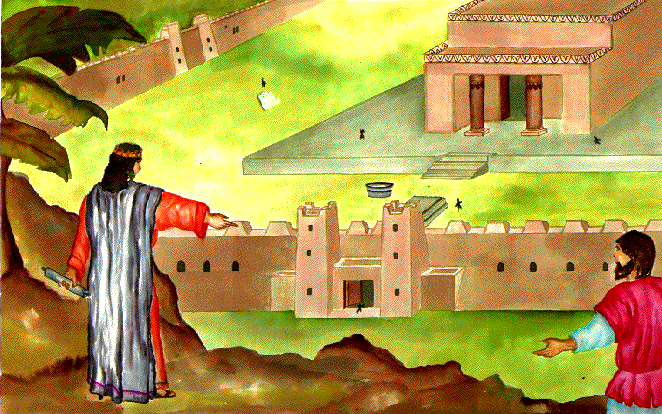 Yesterday I got to read through a portion of 1 Kings. My favourite part of what I read was Solomon's building and dedication of the temple. After reading from Genesis all the way through to 1 Kings, it is a wonderful breath of fresh air!
I think sometimes we lose sight of just how momentous an occasion this really was. Finally... after slavery, the exodus, the 40 years of wandering, the failed conquest of the promised land, the pathetic time of the judges, the first king becoming a miserable failure, a lifetime of war and tumult under David... finally, peace! Finally, God's people are able to construct a permanent fixture where God will be honoured and worshiped. It is the place where he has chosen to make his name dwell. So Solomon has construction of the temple completed, he brings in the ark of the covenant, and offers his prayer of dedication. It's a wonderful scene of celebration and worship of our God as innumerable sacrifices were offered. God is pleased to come down and dwell in his temple--so much so that the priests could not stand to minister in the Holy Place because the glory of YHWH filled the house.
The temple is the place where God dwells and where man can meet with him--the place where God and man dwell together. It is the place where God's glory abides, where he reveals himself to his people.
Solomon's prayer of dedication is then largely concerned with the request of God that whenever God's people pray toward this temple--where God and his people can meet together, where God himself dwells--these prayers will be heard and answered. This is to be true, even when they have sinned, this will be the way they are to pray for reconciliation--pray toward the temple.
And so Solomon, the king, prays for his people. He intercedes for them before the Lord, pleading with God that their sins will be forgiven and that he will have mercy on them.
The glory of God had descended on this place, the Lord had met with his people and heard the prayers of Solomon--why? All of this is made possible--God's people can approach God in his temple--because of the sacrifices they had made. They sacrificed before the ark as they brought it in, and once Solomon had prayed they offered more: 22,000 oxen, and 120,000 sheep as peace offerings to God.
But all of this was still imperfect, in some sense, because we see that where the holiness and the glory of God dwell, the priests still aren't able to be. After a while, the priests are forced to leave the Holy Place where they ministered because of the presence of God.
Of course, what I love the most about all this is Jesus. Where was he? Where wasn't he?! Jesus is the temple--the perfect meeting place of God and man. In him the fullness of deity dwells bodily. He said, 'destroy this temple and I will raise it in three days.' But of course, he was not referring to the temple of stone, but the temple of his flesh--where God and man truly come together. And because he is the fulfillment of the temple, he's also the reason our prayers are offered freely to God now, because we pray through Christ.
But Christ is more than the temple and the reason our prayers are heard. He's also the true Solomon--the true Son of David who will inherit the eternal throne and promises of God. As the true Son of David and the true King, Jesus is the one true intercessor for his people! Now he offers prayers to God on our behalf!
And of course, Jesus is the true sacrifice which makes God's meeting with his people possible at all. Jesus is the perfect 'once for all' sacrifice for the sins of God's people, that every single one of his people would be perfectly covered and able, finally, to meet with God.
And lastly, it has all been made perfect now, through Christ, because we no longer have to worry about imperfect priests, unable to draw near in the earthly temple, because the earthly temple was only ever 'copy' and a 'shadow' anyway! Now, Christ, who is the true high priest, draws near to God in the perfect, heavenly temple on our behalf.
I could go on and on, but this is too long already. What an absolutely wonderful God! What a wonderful Saviour! What a wonderful book that ties all these things so beautifully together. No wonder Christ said he's the fulfillment of the whole thing! He well deserves the name that is above all names.
 I've gone back and forth a bit on this issue, so if you've thought about it, I'd love some input. Here's the question: How much value is there in other world religions? How much time should we spend studying them? When we study them, how should we study them?
Before I went to college, I was of the mindset that there was very little value in getting to know other religions in a meaningful way. For good or for ill, by the time I was done at Heritage, I had come perilously close to being convinced that we needed to know other religions. Buddhists were asking better questions than Christians. Many Muslims are more devout than Christians. World religions like Hinduism, Sikhism, even the Bha'i people, had accumulated great wisdom over the centuries, and Christians would do well to learn from them.
Or would we? Once out of that environment, I began to realize that there were some serious inconsistencies in the ways that I thought. My good friend Rielly had taught me some about the import of the noetic effects of sin (the effects of sin on the mind). My belief in the doctrine of original sin and mankind's total inability also seemed to be at odds with finding wonderful positives in godless, man-made religions.
Today I was pondering a little bit more what exactly I believe with regards to elements of truth in other religions, and how we should react to / interact with them, and I got to thinking about the Bible.
Obviously, things are pretty clear in the Old Testament. God was straight-out against his people having anything to do with the godless nations around them. But much of the crowd at my college seemed (if not always with words, then with attitudes and hermeneutics) to dislike this 'God' and this 'ethic' of the Old Testament and were very happy to proclaim that we have advanced far beyond that type of thing now. So what about the New Testament?
This is where I got stuck. We have Paul's interaction with the pagan philosophers on Mars Hill in Acts, which seems to be the thing that everyone seems to appeal to in order to make their point on this topic. Remarkably, everyonse seems to have their own take on his this interaction should impact our interaction with other religions and our apologetics today. I'm wondering: what other New Testament texts do we look to here? What texts have you found helpful?
What about Jesus? Many emerging-types like to claim that they are 'red letter Christians', not 'Paulians', so we should deal with Christ. They claim that his harsh words were always for the religious hypocrites (Pharisees), never for anyone else. But it seems to me that Jesus would often use the 'Gentiles' / 'nations' (ie. 'pagans') as a negative example. In other words, 'Don't worry, because that's what the pagans do.' Or, 'Don't just love your brother, because that's what the pagans do.' Am I wrong? It would appear that Jesus felt free to hold up the false religions as examples of godless 'morality', whose standards and thoughts ought to be avoided at all cost. As I said, I've gone back and forth on this, so I am open to being wrong again. If you've thought about this already, please advise.
 I don't know why, but for some reason over the past couple of decades it has become trendy to only sing parts of songs. It makes no sense. How can you follow any kind of flow of thought when you're taking chunks out of the middle? You're destroying an artist's work and ripping the people off by not engaging their full minds in all the depth of the meanings of the songs. But I won't go on and on about it, because Tim Challies blogged on this more ably already (see here) from some experiences he had before coming to our church.
All I'll do here is show you one example that I just aboslutely don't get. Most people know the song I Stand in Awe by Mark Altrogge. But here's what blows my mind: Almost no one knows that there are two verses! Why don't people sing the second verse? I have no idea! It's awesome! Here are the words so you can see for yourself.
And if you lead services at your church, sing both verses! If you don't, then tell your pastor that you should sing both verses... please! :)
Everyone should know by now that I love our church. I've written about it elsewhere.
Interestingly enough, the more we grow with each other at Grace Fellowship, the more I realize that we're all weak. It's fantastic to be a part of an authentic church. As people grow in maturity as Christians and in love for one another in Christ, they begin to feel increasingly open to sharing weaknesses and struggles.
Now, I think there are two ways to mess this whole thing up. Churches usually err either by (a) all pretending that they don't struggle with anything, or, (b) all airing their dirty laundry and end up just glorifying and justifying their sin.
In my estimation, it seems that much of the North American church has been caught up in the former for some time now. As a reaction, the emerging church has swung the pendulum to the latter. It has now become trendy to slam myself and talk about what a pharisee and hypocrite I am. I'm supposed to use as many self-deprecating remarks as I can to show the world that I'm more humble than any of those 'conservative evangelical', pew-sitting, hymn-singing, non-arts-loving types.
The result of course is a bunch of people sitting around saying, 'Well, I'm as much of a hypocrite as anyone, so who am I to make any declarations about what is right or wrong?' And of course, everyone ends up staying hypocrites and being okay with everyone being hypocrites because, well, we're all hypocrites! But, hey, at least I recognize it, right?
Hoogly.
The thing I love about our church is that we're growing in what our pastor likes to call 'cross-centred authenticity.' We feel free to be real about who we are, knowing that we're all sinners in desperate need of God's grace. But we know that the cross needs to be at the centre of all we do and say. When someone has sinned, we don't say, 'it's okay, I'm a hypocrite too, don't beat yourself up.' We can point them to the cross, reassuring them that God only sees us in Christ. And because of the cross, we have the Holy Spirit which is given to us to enable us to obey all God's commands. So we can exhort each other on to greater righteousness, knowing that Christ demands absolute perfection.
The reality is that we're all weak. We all struggle in different ways, just like we're gifted in different ways. But that's okay. That's all the more reason to live openly and honestly in front of each other. So that I can let another person's failures act as reminders and warnings to me and let their successes challenge me to greater righteousness.
And ultimately, we must always look to Christ: 'For we do not have a high priest who is unable to sympathize with our weaknesses, but one who in every respect has been tempted as we are, yet without sin.' We must remember that it is through us, the weakest of all, that God has chosen to shame the strength of the world.
Here's a post that a few of you may remember. I posted it a while back on my old blog. I read it today though, and thought it might be worth revisiting. So here it is, with a few minor revisions.
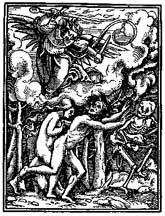 But you know the story... along comes that crafty old serpent to mess everything up. He tempts the humans by saying that what they were wasn't enough... they could be more. They should strive to know more and to be more. Though they had no sin or shame, he tempted them with pride, and they bought it.
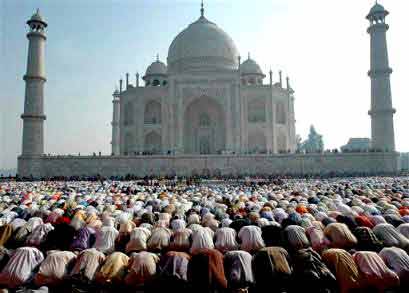 Shame moves us to religion. All the world religions continue to insist that if we work hard to do good, and if we just live like the good people we really are, whatever creator-being there is will be good to us as well. That's pride... it's not an honest evaluation of what's in my heart. But that's the wisdom of this world; the 'wisdom' God saw, when he said 'I will destroy the wisdom of the wise, and the discernment of the discerning I will thwart.'

You are my God, my Life, my Holy Delight. But is this enough to say of you? Can any man say enough when he speaks of you? Yet woe betide him who remains silent about you!
